Filtering refers to the operation of restricting the result set to contain only those elements that satisfy a specified condition. It's also referred to as selecting elements that match the specified condition.
author: BillWagner ms.author: wiwagn ms.topic: include ms.date: 05/29/2024
The following illustration shows the results of filtering a sequence of characters. The predicate for the filtering operation specifies that the character must be 'A'.
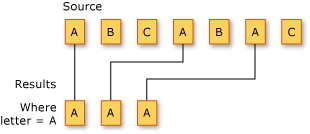
The standard query operator methods that perform selection are listed in the following table:
| Method Name | Description | C# Query Expression Syntax | More Information |
|---|---|---|---|
| OfType | Selects values, depending on their ability to be cast to a specified type. | Not applicable. | System.Linq.Enumerable.OfType System.Linq.Queryable.OfType |
| Where | Selects values that are based on a predicate function. | where |
System.Linq.Enumerable.Where System.Linq.Queryable.Where |
The following example uses the where clause to filter from an array those strings that have a specific length.
author: '' ms.author: '' ms.topic: include ms.date: 08/11/2025
sample · csharpdocs/csharp/linq/standard-query-operators/snippets/standard-query-operators/WhereFilter.csFilterExampleQuery
namespace StandardQueryOperators;
public class WhereFilter
{
    public static void RunAllSnippets()
    {
        WhereSampleQuerySyntax();
        WhereSampleMethodSyntax();
    }

    private static void WhereSampleQuerySyntax()
    {
        // <FilterExampleQuery>
        string[] words = ["the", "quick", "brown", "fox", "jumps"];

        IEnumerable<string> query = from word in words
                                    where word.Length == 3
                                    select word;

        foreach (string str in query)
        {
            Console.WriteLine(str);
        }

        /* This code produces the following output:

            the
            fox
        */
        // </FilterExampleQuery>
    }

    private static void WhereSampleMethodSyntax()
    {
        // <FilterExampleMethod>
        string[] words = ["the", "quick", "brown", "fox", "jumps"];

        IEnumerable<string> query =
            words.Where(word => word.Length == 3);

        foreach (string str in query)
        {
            Console.WriteLine(str);
        }

        /* This code produces the following output:

            the
            fox
        */
        // </FilterExampleMethod>
    }
}
The equivalent query using method syntax is shown in the following code:
sample · csharpdocs/csharp/linq/standard-query-operators/snippets/standard-query-operators/WhereFilter.csFilterExampleMethod
namespace StandardQueryOperators;
public class WhereFilter
{
    public static void RunAllSnippets()
    {
        WhereSampleQuerySyntax();
        WhereSampleMethodSyntax();
    }

    private static void WhereSampleQuerySyntax()
    {
        // <FilterExampleQuery>
        string[] words = ["the", "quick", "brown", "fox", "jumps"];

        IEnumerable<string> query = from word in words
                                    where word.Length == 3
                                    select word;

        foreach (string str in query)
        {
            Console.WriteLine(str);
        }

        /* This code produces the following output:

            the
            fox
        */
        // </FilterExampleQuery>
    }

    private static void WhereSampleMethodSyntax()
    {
        // <FilterExampleMethod>
        string[] words = ["the", "quick", "brown", "fox", "jumps"];

        IEnumerable<string> query =
            words.Where(word => word.Length == 3);

        foreach (string str in query)
        {
            Console.WriteLine(str);
        }

        /* This code produces the following output:

            the
            fox
        */
        // </FilterExampleMethod>
    }
}