Projection refers to the operation of transforming an object into a new form that often consists only of those properties subsequently used. By using projection, you can construct a new type that is built from each object. You can project a property and perform a mathematical function on it. You can also project the original object without changing it.
author: BillWagner ms.author: wiwagn ms.topic: include ms.date: 05/29/2024
The standard query operator methods that perform projection are listed in the following section.
Methods
| Method names | Description | C# query expression syntax | More information |
|---|---|---|---|
| Select | Projects values that are based on a transform function. | select |
System.Linq.Enumerable.Select System.Linq.Queryable.Select |
| SelectMany | Projects sequences of values that are based on a transform function and then flattens them into one sequence. | Use multiple from clauses |
System.Linq.Enumerable.SelectMany System.Linq.Queryable.SelectMany |
| Zip | Produces a sequence of tuples with elements from 2-3 specified sequences. | Not applicable. | System.Linq.Enumerable.Zip System.Linq.Queryable.Zip |
Select
The following example uses the select clause to project the first letter from each string in a list of strings.
author: '' ms.author: '' ms.topic: include ms.date: 08/11/2025
sample · csharpdocs/csharp/linq/standard-query-operators/snippets/standard-query-operators/SelectProjectionExamples.csSelectSimpleQuery
using System.Text;

namespace StandardQueryOperators;
internal class SelectProjectionExamples
{
    public static void RunAllSnippets()
    {
        SelectSimpleQuerySyntax();
        SelectSimpleMethodSyntax();
        SelectManyQuerySyntax();
        SelectManyMethodSyntax();
        NumbersAndLetters();
        SelectVsSelectMany();
    }

    private static void SelectSimpleQuerySyntax()
    {
        // <SelectSimpleQuery>
        List<string> words = ["an", "apple", "a", "day"];

        var query = from word in words
                    select word.Substring(0, 1);

        foreach (string s in query)
        {
            Console.WriteLine(s);
        }

        /* This code produces the following output:

            a
            a
            a
            d
        */
        // </SelectSimpleQuery>
    }

    private static void SelectSimpleMethodSyntax()
    {
        // <SelectSimpleMethod>
        List<string> words = ["an", "apple", "a", "day"];

        var query = words.Select(word => word.Substring(0, 1));

        foreach (string s in query)
        {
            Console.WriteLine(s);
        }

        /* This code produces the following output:

            a
            a
            a
            d
        */
        // </SelectSimpleMethod>
    }
    private static void SelectManyQuerySyntax()
    {
        // <SelectManyQuery>
        List<string> phrases = ["an apple a day", "the quick brown fox"];

        var query = from phrase in phrases
                    from word in phrase.Split(' ')
                    select word;

        foreach (string s in query)
        {
            Console.WriteLine(s);
        }

        /* This code produces the following output:

            an
            apple
            a
            day
            the
            quick
            brown
            fox
        */
        // </SelectManyQuery>
    }

    private static void SelectManyMethodSyntax()
    {
        // <SelectManyMethod>
        List<string> phrases = ["an apple a day", "the quick brown fox"];

        var query = phrases.SelectMany(phrase => phrase.Split(' '));

        foreach (string s in query)
        {
            Console.WriteLine(s);
        }

        /* This code produces the following output:

            an
            apple
            a
            day
            the
            quick
            brown
            fox
        */
        // </SelectManyMethod>
    }
    private static void NumbersAndLetters()
    {
        Console.OutputEncoding = Encoding.UTF8;

        // <NumbersAndLetters>
        // An int array with 7 elements.
        IEnumerable<int> numbers = [1, 2, 3, 4, 5, 6, 7];
        // A char array with 6 elements.
        IEnumerable<char> letters = ['A', 'B', 'C', 'D', 'E', 'F'];
        // </NumbersAndLetters>

        // <Emoji>
        // A string array with 8 elements.
        IEnumerable<string> emoji = [ "🤓", "🔥", "🎉", "👀", "⭐", "💜", "✔", "💯"];
        // </Emoji>

        // <SelectManyQuery2>
        var query = from number in numbers
                    from letter in letters
                    select (number, letter);

        foreach (var item in query)
        {
            Console.WriteLine(item);
        }
        // </SelectManyQuery2>

        // <SelectManyMethod2>
        var method = numbers
            .SelectMany(number => letters,
            (number, letter) => (number, letter));

        foreach (var item in method)
        {
            Console.WriteLine(item);
        }
        // </SelectManyMethod2>

        ZipTupleExample(numbers, letters);
        ZipTripleExample(numbers, letters, emoji);
        ZipResultExample(numbers, letters);
    }

    private static void ZipTupleExample(
        IEnumerable<int> numbers,
        IEnumerable<char> letters)
    {
        Console.WriteLine("Zip (TFirst, TSecond):");

        // <ZipTuple>
        foreach ((int number, char letter) in numbers.Zip(letters))
        {
            Console.WriteLine($"Number: {number} zipped with letter: '{letter}'");
        }
        // This code produces the following output:
        //     Number: 1 zipped with letter: 'A'
        //     Number: 2 zipped with letter: 'B'
        //     Number: 3 zipped with letter: 'C'
        //     Number: 4 zipped with letter: 'D'
        //     Number: 5 zipped with letter: 'E'
        //     Number: 6 zipped with letter: 'F'
        // </ZipTuple>

        Console.WriteLine();
    }

    private static void ZipResultExample(
        IEnumerable<int> numbers,
        IEnumerable<char> letters)
    {
        Console.WriteLine("Zip (TFirst, TSecond, Func<TFirst, TSecond, TResult>):");

        // <ZipResultSelector>
        foreach (string result in
            numbers.Zip(letters, (number, letter) => $"{number} = {letter} ({(int)letter})"))
        {
            Console.WriteLine(result);
        }
        // This code produces the following output:
        //     1 = A (65)
        //     2 = B (66)
        //     3 = C (67)
        //     4 = D (68)
        //     5 = E (69)
        //     6 = F (70)
        // </ZipResultSelector>

        Console.WriteLine();
    }

    private static void ZipTripleExample(
        IEnumerable<int> numbers,
        IEnumerable<char> letters,
        IEnumerable<string> emoji)
    {
        Console.WriteLine("Zip (TFirst, TSecond, TThird):");

        // <ZipTriple>
        foreach ((int number, char letter, string em) in numbers.Zip(letters, emoji))
        {
            Console.WriteLine(
                $"Number: {number} is zipped with letter: '{letter}' and emoji: {em}");
        }
        // This code produces the following output:
        //     Number: 1 is zipped with letter: 'A' and emoji: 🤓
        //     Number: 2 is zipped with letter: 'B' and emoji: 🔥
        //     Number: 3 is zipped with letter: 'C' and emoji: 🎉
        //     Number: 4 is zipped with letter: 'D' and emoji: 👀
        //     Number: 5 is zipped with letter: 'E' and emoji: ⭐
        //     Number: 6 is zipped with letter: 'F' and emoji: 💜
        // </ZipTriple>

        Console.WriteLine();
    }

    // <SelectVsSelectMany>
    class Bouquet
    {
        public required List<string> Flowers { get; init; }
    }

    static void SelectVsSelectMany()
    {
        List<Bouquet> bouquets =
        [
            new Bouquet { Flowers = ["sunflower", "daisy", "daffodil", "larkspur"] },
            new Bouquet { Flowers = ["tulip", "rose", "orchid"] },
            new Bouquet { Flowers = ["gladiolis", "lily", "snapdragon", "aster", "protea"] },
            new Bouquet { Flowers = ["larkspur", "lilac", "iris", "dahlia"] }
        ];

        IEnumerable<List<string>> query1 = bouquets.Select(bq => bq.Flowers);

        IEnumerable<string> query2 = bouquets.SelectMany(bq => bq.Flowers);

        Console.WriteLine("Results by using Select():");
        // Note the extra foreach loop here.
        foreach (IEnumerable<string> collection in query1)
        {
            foreach (string item in collection)
            {
                Console.WriteLine(item);
            }
        }

        Console.WriteLine("\nResults by using SelectMany():");
        foreach (string item in query2)
        {
            Console.WriteLine(item);
        }
    }
    // </SelectVsSelectMany>
}
The equivalent query using method syntax is shown in the following code:
sample · csharpdocs/csharp/linq/standard-query-operators/snippets/standard-query-operators/SelectProjectionExamples.csSelectSimpleMethod
using System.Text;

namespace StandardQueryOperators;
internal class SelectProjectionExamples
{
    public static void RunAllSnippets()
    {
        SelectSimpleQuerySyntax();
        SelectSimpleMethodSyntax();
        SelectManyQuerySyntax();
        SelectManyMethodSyntax();
        NumbersAndLetters();
        SelectVsSelectMany();
    }

    private static void SelectSimpleQuerySyntax()
    {
        // <SelectSimpleQuery>
        List<string> words = ["an", "apple", "a", "day"];

        var query = from word in words
                    select word.Substring(0, 1);

        foreach (string s in query)
        {
            Console.WriteLine(s);
        }

        /* This code produces the following output:

            a
            a
            a
            d
        */
        // </SelectSimpleQuery>
    }

    private static void SelectSimpleMethodSyntax()
    {
        // <SelectSimpleMethod>
        List<string> words = ["an", "apple", "a", "day"];

        var query = words.Select(word => word.Substring(0, 1));

        foreach (string s in query)
        {
            Console.WriteLine(s);
        }

        /* This code produces the following output:

            a
            a
            a
            d
        */
        // </SelectSimpleMethod>
    }
    private static void SelectManyQuerySyntax()
    {
        // <SelectManyQuery>
        List<string> phrases = ["an apple a day", "the quick brown fox"];

        var query = from phrase in phrases
                    from word in phrase.Split(' ')
                    select word;

        foreach (string s in query)
        {
            Console.WriteLine(s);
        }

        /* This code produces the following output:

            an
            apple
            a
            day
            the
            quick
            brown
            fox
        */
        // </SelectManyQuery>
    }

    private static void SelectManyMethodSyntax()
    {
        // <SelectManyMethod>
        List<string> phrases = ["an apple a day", "the quick brown fox"];

        var query = phrases.SelectMany(phrase => phrase.Split(' '));

        foreach (string s in query)
        {
            Console.WriteLine(s);
        }

        /* This code produces the following output:

            an
            apple
            a
            day
            the
            quick
            brown
            fox
        */
        // </SelectManyMethod>
    }
    private static void NumbersAndLetters()
    {
        Console.OutputEncoding = Encoding.UTF8;

        // <NumbersAndLetters>
        // An int array with 7 elements.
        IEnumerable<int> numbers = [1, 2, 3, 4, 5, 6, 7];
        // A char array with 6 elements.
        IEnumerable<char> letters = ['A', 'B', 'C', 'D', 'E', 'F'];
        // </NumbersAndLetters>

        // <Emoji>
        // A string array with 8 elements.
        IEnumerable<string> emoji = [ "🤓", "🔥", "🎉", "👀", "⭐", "💜", "✔", "💯"];
        // </Emoji>

        // <SelectManyQuery2>
        var query = from number in numbers
                    from letter in letters
                    select (number, letter);

        foreach (var item in query)
        {
            Console.WriteLine(item);
        }
        // </SelectManyQuery2>

        // <SelectManyMethod2>
        var method = numbers
            .SelectMany(number => letters,
            (number, letter) => (number, letter));

        foreach (var item in method)
        {
            Console.WriteLine(item);
        }
        // </SelectManyMethod2>

        ZipTupleExample(numbers, letters);
        ZipTripleExample(numbers, letters, emoji);
        ZipResultExample(numbers, letters);
    }

    private static void ZipTupleExample(
        IEnumerable<int> numbers,
        IEnumerable<char> letters)
    {
        Console.WriteLine("Zip (TFirst, TSecond):");

        // <ZipTuple>
        foreach ((int number, char letter) in numbers.Zip(letters))
        {
            Console.WriteLine($"Number: {number} zipped with letter: '{letter}'");
        }
        // This code produces the following output:
        //     Number: 1 zipped with letter: 'A'
        //     Number: 2 zipped with letter: 'B'
        //     Number: 3 zipped with letter: 'C'
        //     Number: 4 zipped with letter: 'D'
        //     Number: 5 zipped with letter: 'E'
        //     Number: 6 zipped with letter: 'F'
        // </ZipTuple>

        Console.WriteLine();
    }

    private static void ZipResultExample(
        IEnumerable<int> numbers,
        IEnumerable<char> letters)
    {
        Console.WriteLine("Zip (TFirst, TSecond, Func<TFirst, TSecond, TResult>):");

        // <ZipResultSelector>
        foreach (string result in
            numbers.Zip(letters, (number, letter) => $"{number} = {letter} ({(int)letter})"))
        {
            Console.WriteLine(result);
        }
        // This code produces the following output:
        //     1 = A (65)
        //     2 = B (66)
        //     3 = C (67)
        //     4 = D (68)
        //     5 = E (69)
        //     6 = F (70)
        // </ZipResultSelector>

        Console.WriteLine();
    }

    private static void ZipTripleExample(
        IEnumerable<int> numbers,
        IEnumerable<char> letters,
        IEnumerable<string> emoji)
    {
        Console.WriteLine("Zip (TFirst, TSecond, TThird):");

        // <ZipTriple>
        foreach ((int number, char letter, string em) in numbers.Zip(letters, emoji))
        {
            Console.WriteLine(
                $"Number: {number} is zipped with letter: '{letter}' and emoji: {em}");
        }
        // This code produces the following output:
        //     Number: 1 is zipped with letter: 'A' and emoji: 🤓
        //     Number: 2 is zipped with letter: 'B' and emoji: 🔥
        //     Number: 3 is zipped with letter: 'C' and emoji: 🎉
        //     Number: 4 is zipped with letter: 'D' and emoji: 👀
        //     Number: 5 is zipped with letter: 'E' and emoji: ⭐
        //     Number: 6 is zipped with letter: 'F' and emoji: 💜
        // </ZipTriple>

        Console.WriteLine();
    }

    // <SelectVsSelectMany>
    class Bouquet
    {
        public required List<string> Flowers { get; init; }
    }

    static void SelectVsSelectMany()
    {
        List<Bouquet> bouquets =
        [
            new Bouquet { Flowers = ["sunflower", "daisy", "daffodil", "larkspur"] },
            new Bouquet { Flowers = ["tulip", "rose", "orchid"] },
            new Bouquet { Flowers = ["gladiolis", "lily", "snapdragon", "aster", "protea"] },
            new Bouquet { Flowers = ["larkspur", "lilac", "iris", "dahlia"] }
        ];

        IEnumerable<List<string>> query1 = bouquets.Select(bq => bq.Flowers);

        IEnumerable<string> query2 = bouquets.SelectMany(bq => bq.Flowers);

        Console.WriteLine("Results by using Select():");
        // Note the extra foreach loop here.
        foreach (IEnumerable<string> collection in query1)
        {
            foreach (string item in collection)
            {
                Console.WriteLine(item);
            }
        }

        Console.WriteLine("\nResults by using SelectMany():");
        foreach (string item in query2)
        {
            Console.WriteLine(item);
        }
    }
    // </SelectVsSelectMany>
}SelectMany
The following example uses multiple from clauses to project each word from each string in a list of strings.
sample · csharpdocs/csharp/linq/standard-query-operators/snippets/standard-query-operators/SelectProjectionExamples.csSelectManyQuery
using System.Text;

namespace StandardQueryOperators;
internal class SelectProjectionExamples
{
    public static void RunAllSnippets()
    {
        SelectSimpleQuerySyntax();
        SelectSimpleMethodSyntax();
        SelectManyQuerySyntax();
        SelectManyMethodSyntax();
        NumbersAndLetters();
        SelectVsSelectMany();
    }

    private static void SelectSimpleQuerySyntax()
    {
        // <SelectSimpleQuery>
        List<string> words = ["an", "apple", "a", "day"];

        var query = from word in words
                    select word.Substring(0, 1);

        foreach (string s in query)
        {
            Console.WriteLine(s);
        }

        /* This code produces the following output:

            a
            a
            a
            d
        */
        // </SelectSimpleQuery>
    }

    private static void SelectSimpleMethodSyntax()
    {
        // <SelectSimpleMethod>
        List<string> words = ["an", "apple", "a", "day"];

        var query = words.Select(word => word.Substring(0, 1));

        foreach (string s in query)
        {
            Console.WriteLine(s);
        }

        /* This code produces the following output:

            a
            a
            a
            d
        */
        // </SelectSimpleMethod>
    }
    private static void SelectManyQuerySyntax()
    {
        // <SelectManyQuery>
        List<string> phrases = ["an apple a day", "the quick brown fox"];

        var query = from phrase in phrases
                    from word in phrase.Split(' ')
                    select word;

        foreach (string s in query)
        {
            Console.WriteLine(s);
        }

        /* This code produces the following output:

            an
            apple
            a
            day
            the
            quick
            brown
            fox
        */
        // </SelectManyQuery>
    }

    private static void SelectManyMethodSyntax()
    {
        // <SelectManyMethod>
        List<string> phrases = ["an apple a day", "the quick brown fox"];

        var query = phrases.SelectMany(phrase => phrase.Split(' '));

        foreach (string s in query)
        {
            Console.WriteLine(s);
        }

        /* This code produces the following output:

            an
            apple
            a
            day
            the
            quick
            brown
            fox
        */
        // </SelectManyMethod>
    }
    private static void NumbersAndLetters()
    {
        Console.OutputEncoding = Encoding.UTF8;

        // <NumbersAndLetters>
        // An int array with 7 elements.
        IEnumerable<int> numbers = [1, 2, 3, 4, 5, 6, 7];
        // A char array with 6 elements.
        IEnumerable<char> letters = ['A', 'B', 'C', 'D', 'E', 'F'];
        // </NumbersAndLetters>

        // <Emoji>
        // A string array with 8 elements.
        IEnumerable<string> emoji = [ "🤓", "🔥", "🎉", "👀", "⭐", "💜", "✔", "💯"];
        // </Emoji>

        // <SelectManyQuery2>
        var query = from number in numbers
                    from letter in letters
                    select (number, letter);

        foreach (var item in query)
        {
            Console.WriteLine(item);
        }
        // </SelectManyQuery2>

        // <SelectManyMethod2>
        var method = numbers
            .SelectMany(number => letters,
            (number, letter) => (number, letter));

        foreach (var item in method)
        {
            Console.WriteLine(item);
        }
        // </SelectManyMethod2>

        ZipTupleExample(numbers, letters);
        ZipTripleExample(numbers, letters, emoji);
        ZipResultExample(numbers, letters);
    }

    private static void ZipTupleExample(
        IEnumerable<int> numbers,
        IEnumerable<char> letters)
    {
        Console.WriteLine("Zip (TFirst, TSecond):");

        // <ZipTuple>
        foreach ((int number, char letter) in numbers.Zip(letters))
        {
            Console.WriteLine($"Number: {number} zipped with letter: '{letter}'");
        }
        // This code produces the following output:
        //     Number: 1 zipped with letter: 'A'
        //     Number: 2 zipped with letter: 'B'
        //     Number: 3 zipped with letter: 'C'
        //     Number: 4 zipped with letter: 'D'
        //     Number: 5 zipped with letter: 'E'
        //     Number: 6 zipped with letter: 'F'
        // </ZipTuple>

        Console.WriteLine();
    }

    private static void ZipResultExample(
        IEnumerable<int> numbers,
        IEnumerable<char> letters)
    {
        Console.WriteLine("Zip (TFirst, TSecond, Func<TFirst, TSecond, TResult>):");

        // <ZipResultSelector>
        foreach (string result in
            numbers.Zip(letters, (number, letter) => $"{number} = {letter} ({(int)letter})"))
        {
            Console.WriteLine(result);
        }
        // This code produces the following output:
        //     1 = A (65)
        //     2 = B (66)
        //     3 = C (67)
        //     4 = D (68)
        //     5 = E (69)
        //     6 = F (70)
        // </ZipResultSelector>

        Console.WriteLine();
    }

    private static void ZipTripleExample(
        IEnumerable<int> numbers,
        IEnumerable<char> letters,
        IEnumerable<string> emoji)
    {
        Console.WriteLine("Zip (TFirst, TSecond, TThird):");

        // <ZipTriple>
        foreach ((int number, char letter, string em) in numbers.Zip(letters, emoji))
        {
            Console.WriteLine(
                $"Number: {number} is zipped with letter: '{letter}' and emoji: {em}");
        }
        // This code produces the following output:
        //     Number: 1 is zipped with letter: 'A' and emoji: 🤓
        //     Number: 2 is zipped with letter: 'B' and emoji: 🔥
        //     Number: 3 is zipped with letter: 'C' and emoji: 🎉
        //     Number: 4 is zipped with letter: 'D' and emoji: 👀
        //     Number: 5 is zipped with letter: 'E' and emoji: ⭐
        //     Number: 6 is zipped with letter: 'F' and emoji: 💜
        // </ZipTriple>

        Console.WriteLine();
    }

    // <SelectVsSelectMany>
    class Bouquet
    {
        public required List<string> Flowers { get; init; }
    }

    static void SelectVsSelectMany()
    {
        List<Bouquet> bouquets =
        [
            new Bouquet { Flowers = ["sunflower", "daisy", "daffodil", "larkspur"] },
            new Bouquet { Flowers = ["tulip", "rose", "orchid"] },
            new Bouquet { Flowers = ["gladiolis", "lily", "snapdragon", "aster", "protea"] },
            new Bouquet { Flowers = ["larkspur", "lilac", "iris", "dahlia"] }
        ];

        IEnumerable<List<string>> query1 = bouquets.Select(bq => bq.Flowers);

        IEnumerable<string> query2 = bouquets.SelectMany(bq => bq.Flowers);

        Console.WriteLine("Results by using Select():");
        // Note the extra foreach loop here.
        foreach (IEnumerable<string> collection in query1)
        {
            foreach (string item in collection)
            {
                Console.WriteLine(item);
            }
        }

        Console.WriteLine("\nResults by using SelectMany():");
        foreach (string item in query2)
        {
            Console.WriteLine(item);
        }
    }
    // </SelectVsSelectMany>
}
The equivalent query using method syntax is shown in the following code:
sample · csharpdocs/csharp/linq/standard-query-operators/snippets/standard-query-operators/SelectProjectionExamples.csSelectManyMethod
using System.Text;

namespace StandardQueryOperators;
internal class SelectProjectionExamples
{
    public static void RunAllSnippets()
    {
        SelectSimpleQuerySyntax();
        SelectSimpleMethodSyntax();
        SelectManyQuerySyntax();
        SelectManyMethodSyntax();
        NumbersAndLetters();
        SelectVsSelectMany();
    }

    private static void SelectSimpleQuerySyntax()
    {
        // <SelectSimpleQuery>
        List<string> words = ["an", "apple", "a", "day"];

        var query = from word in words
                    select word.Substring(0, 1);

        foreach (string s in query)
        {
            Console.WriteLine(s);
        }

        /* This code produces the following output:

            a
            a
            a
            d
        */
        // </SelectSimpleQuery>
    }

    private static void SelectSimpleMethodSyntax()
    {
        // <SelectSimpleMethod>
        List<string> words = ["an", "apple", "a", "day"];

        var query = words.Select(word => word.Substring(0, 1));

        foreach (string s in query)
        {
            Console.WriteLine(s);
        }

        /* This code produces the following output:

            a
            a
            a
            d
        */
        // </SelectSimpleMethod>
    }
    private static void SelectManyQuerySyntax()
    {
        // <SelectManyQuery>
        List<string> phrases = ["an apple a day", "the quick brown fox"];

        var query = from phrase in phrases
                    from word in phrase.Split(' ')
                    select word;

        foreach (string s in query)
        {
            Console.WriteLine(s);
        }

        /* This code produces the following output:

            an
            apple
            a
            day
            the
            quick
            brown
            fox
        */
        // </SelectManyQuery>
    }

    private static void SelectManyMethodSyntax()
    {
        // <SelectManyMethod>
        List<string> phrases = ["an apple a day", "the quick brown fox"];

        var query = phrases.SelectMany(phrase => phrase.Split(' '));

        foreach (string s in query)
        {
            Console.WriteLine(s);
        }

        /* This code produces the following output:

            an
            apple
            a
            day
            the
            quick
            brown
            fox
        */
        // </SelectManyMethod>
    }
    private static void NumbersAndLetters()
    {
        Console.OutputEncoding = Encoding.UTF8;

        // <NumbersAndLetters>
        // An int array with 7 elements.
        IEnumerable<int> numbers = [1, 2, 3, 4, 5, 6, 7];
        // A char array with 6 elements.
        IEnumerable<char> letters = ['A', 'B', 'C', 'D', 'E', 'F'];
        // </NumbersAndLetters>

        // <Emoji>
        // A string array with 8 elements.
        IEnumerable<string> emoji = [ "🤓", "🔥", "🎉", "👀", "⭐", "💜", "✔", "💯"];
        // </Emoji>

        // <SelectManyQuery2>
        var query = from number in numbers
                    from letter in letters
                    select (number, letter);

        foreach (var item in query)
        {
            Console.WriteLine(item);
        }
        // </SelectManyQuery2>

        // <SelectManyMethod2>
        var method = numbers
            .SelectMany(number => letters,
            (number, letter) => (number, letter));

        foreach (var item in method)
        {
            Console.WriteLine(item);
        }
        // </SelectManyMethod2>

        ZipTupleExample(numbers, letters);
        ZipTripleExample(numbers, letters, emoji);
        ZipResultExample(numbers, letters);
    }

    private static void ZipTupleExample(
        IEnumerable<int> numbers,
        IEnumerable<char> letters)
    {
        Console.WriteLine("Zip (TFirst, TSecond):");

        // <ZipTuple>
        foreach ((int number, char letter) in numbers.Zip(letters))
        {
            Console.WriteLine($"Number: {number} zipped with letter: '{letter}'");
        }
        // This code produces the following output:
        //     Number: 1 zipped with letter: 'A'
        //     Number: 2 zipped with letter: 'B'
        //     Number: 3 zipped with letter: 'C'
        //     Number: 4 zipped with letter: 'D'
        //     Number: 5 zipped with letter: 'E'
        //     Number: 6 zipped with letter: 'F'
        // </ZipTuple>

        Console.WriteLine();
    }

    private static void ZipResultExample(
        IEnumerable<int> numbers,
        IEnumerable<char> letters)
    {
        Console.WriteLine("Zip (TFirst, TSecond, Func<TFirst, TSecond, TResult>):");

        // <ZipResultSelector>
        foreach (string result in
            numbers.Zip(letters, (number, letter) => $"{number} = {letter} ({(int)letter})"))
        {
            Console.WriteLine(result);
        }
        // This code produces the following output:
        //     1 = A (65)
        //     2 = B (66)
        //     3 = C (67)
        //     4 = D (68)
        //     5 = E (69)
        //     6 = F (70)
        // </ZipResultSelector>

        Console.WriteLine();
    }

    private static void ZipTripleExample(
        IEnumerable<int> numbers,
        IEnumerable<char> letters,
        IEnumerable<string> emoji)
    {
        Console.WriteLine("Zip (TFirst, TSecond, TThird):");

        // <ZipTriple>
        foreach ((int number, char letter, string em) in numbers.Zip(letters, emoji))
        {
            Console.WriteLine(
                $"Number: {number} is zipped with letter: '{letter}' and emoji: {em}");
        }
        // This code produces the following output:
        //     Number: 1 is zipped with letter: 'A' and emoji: 🤓
        //     Number: 2 is zipped with letter: 'B' and emoji: 🔥
        //     Number: 3 is zipped with letter: 'C' and emoji: 🎉
        //     Number: 4 is zipped with letter: 'D' and emoji: 👀
        //     Number: 5 is zipped with letter: 'E' and emoji: ⭐
        //     Number: 6 is zipped with letter: 'F' and emoji: 💜
        // </ZipTriple>

        Console.WriteLine();
    }

    // <SelectVsSelectMany>
    class Bouquet
    {
        public required List<string> Flowers { get; init; }
    }

    static void SelectVsSelectMany()
    {
        List<Bouquet> bouquets =
        [
            new Bouquet { Flowers = ["sunflower", "daisy", "daffodil", "larkspur"] },
            new Bouquet { Flowers = ["tulip", "rose", "orchid"] },
            new Bouquet { Flowers = ["gladiolis", "lily", "snapdragon", "aster", "protea"] },
            new Bouquet { Flowers = ["larkspur", "lilac", "iris", "dahlia"] }
        ];

        IEnumerable<List<string>> query1 = bouquets.Select(bq => bq.Flowers);

        IEnumerable<string> query2 = bouquets.SelectMany(bq => bq.Flowers);

        Console.WriteLine("Results by using Select():");
        // Note the extra foreach loop here.
        foreach (IEnumerable<string> collection in query1)
        {
            foreach (string item in collection)
            {
                Console.WriteLine(item);
            }
        }

        Console.WriteLine("\nResults by using SelectMany():");
        foreach (string item in query2)
        {
            Console.WriteLine(item);
        }
    }
    // </SelectVsSelectMany>
}
The SelectMany method can also form the combination of matching every item in the first sequence with every item in the second sequence:
sample · csharpdocs/csharp/linq/standard-query-operators/snippets/standard-query-operators/SelectProjectionExamples.csSelectManyQuery2
using System.Text;

namespace StandardQueryOperators;
internal class SelectProjectionExamples
{
    public static void RunAllSnippets()
    {
        SelectSimpleQuerySyntax();
        SelectSimpleMethodSyntax();
        SelectManyQuerySyntax();
        SelectManyMethodSyntax();
        NumbersAndLetters();
        SelectVsSelectMany();
    }

    private static void SelectSimpleQuerySyntax()
    {
        // <SelectSimpleQuery>
        List<string> words = ["an", "apple", "a", "day"];

        var query = from word in words
                    select word.Substring(0, 1);

        foreach (string s in query)
        {
            Console.WriteLine(s);
        }

        /* This code produces the following output:

            a
            a
            a
            d
        */
        // </SelectSimpleQuery>
    }

    private static void SelectSimpleMethodSyntax()
    {
        // <SelectSimpleMethod>
        List<string> words = ["an", "apple", "a", "day"];

        var query = words.Select(word => word.Substring(0, 1));

        foreach (string s in query)
        {
            Console.WriteLine(s);
        }

        /* This code produces the following output:

            a
            a
            a
            d
        */
        // </SelectSimpleMethod>
    }
    private static void SelectManyQuerySyntax()
    {
        // <SelectManyQuery>
        List<string> phrases = ["an apple a day", "the quick brown fox"];

        var query = from phrase in phrases
                    from word in phrase.Split(' ')
                    select word;

        foreach (string s in query)
        {
            Console.WriteLine(s);
        }

        /* This code produces the following output:

            an
            apple
            a
            day
            the
            quick
            brown
            fox
        */
        // </SelectManyQuery>
    }

    private static void SelectManyMethodSyntax()
    {
        // <SelectManyMethod>
        List<string> phrases = ["an apple a day", "the quick brown fox"];

        var query = phrases.SelectMany(phrase => phrase.Split(' '));

        foreach (string s in query)
        {
            Console.WriteLine(s);
        }

        /* This code produces the following output:

            an
            apple
            a
            day
            the
            quick
            brown
            fox
        */
        // </SelectManyMethod>
    }
    private static void NumbersAndLetters()
    {
        Console.OutputEncoding = Encoding.UTF8;

        // <NumbersAndLetters>
        // An int array with 7 elements.
        IEnumerable<int> numbers = [1, 2, 3, 4, 5, 6, 7];
        // A char array with 6 elements.
        IEnumerable<char> letters = ['A', 'B', 'C', 'D', 'E', 'F'];
        // </NumbersAndLetters>

        // <Emoji>
        // A string array with 8 elements.
        IEnumerable<string> emoji = [ "🤓", "🔥", "🎉", "👀", "⭐", "💜", "✔", "💯"];
        // </Emoji>

        // <SelectManyQuery2>
        var query = from number in numbers
                    from letter in letters
                    select (number, letter);

        foreach (var item in query)
        {
            Console.WriteLine(item);
        }
        // </SelectManyQuery2>

        // <SelectManyMethod2>
        var method = numbers
            .SelectMany(number => letters,
            (number, letter) => (number, letter));

        foreach (var item in method)
        {
            Console.WriteLine(item);
        }
        // </SelectManyMethod2>

        ZipTupleExample(numbers, letters);
        ZipTripleExample(numbers, letters, emoji);
        ZipResultExample(numbers, letters);
    }

    private static void ZipTupleExample(
        IEnumerable<int> numbers,
        IEnumerable<char> letters)
    {
        Console.WriteLine("Zip (TFirst, TSecond):");

        // <ZipTuple>
        foreach ((int number, char letter) in numbers.Zip(letters))
        {
            Console.WriteLine($"Number: {number} zipped with letter: '{letter}'");
        }
        // This code produces the following output:
        //     Number: 1 zipped with letter: 'A'
        //     Number: 2 zipped with letter: 'B'
        //     Number: 3 zipped with letter: 'C'
        //     Number: 4 zipped with letter: 'D'
        //     Number: 5 zipped with letter: 'E'
        //     Number: 6 zipped with letter: 'F'
        // </ZipTuple>

        Console.WriteLine();
    }

    private static void ZipResultExample(
        IEnumerable<int> numbers,
        IEnumerable<char> letters)
    {
        Console.WriteLine("Zip (TFirst, TSecond, Func<TFirst, TSecond, TResult>):");

        // <ZipResultSelector>
        foreach (string result in
            numbers.Zip(letters, (number, letter) => $"{number} = {letter} ({(int)letter})"))
        {
            Console.WriteLine(result);
        }
        // This code produces the following output:
        //     1 = A (65)
        //     2 = B (66)
        //     3 = C (67)
        //     4 = D (68)
        //     5 = E (69)
        //     6 = F (70)
        // </ZipResultSelector>

        Console.WriteLine();
    }

    private static void ZipTripleExample(
        IEnumerable<int> numbers,
        IEnumerable<char> letters,
        IEnumerable<string> emoji)
    {
        Console.WriteLine("Zip (TFirst, TSecond, TThird):");

        // <ZipTriple>
        foreach ((int number, char letter, string em) in numbers.Zip(letters, emoji))
        {
            Console.WriteLine(
                $"Number: {number} is zipped with letter: '{letter}' and emoji: {em}");
        }
        // This code produces the following output:
        //     Number: 1 is zipped with letter: 'A' and emoji: 🤓
        //     Number: 2 is zipped with letter: 'B' and emoji: 🔥
        //     Number: 3 is zipped with letter: 'C' and emoji: 🎉
        //     Number: 4 is zipped with letter: 'D' and emoji: 👀
        //     Number: 5 is zipped with letter: 'E' and emoji: ⭐
        //     Number: 6 is zipped with letter: 'F' and emoji: 💜
        // </ZipTriple>

        Console.WriteLine();
    }

    // <SelectVsSelectMany>
    class Bouquet
    {
        public required List<string> Flowers { get; init; }
    }

    static void SelectVsSelectMany()
    {
        List<Bouquet> bouquets =
        [
            new Bouquet { Flowers = ["sunflower", "daisy", "daffodil", "larkspur"] },
            new Bouquet { Flowers = ["tulip", "rose", "orchid"] },
            new Bouquet { Flowers = ["gladiolis", "lily", "snapdragon", "aster", "protea"] },
            new Bouquet { Flowers = ["larkspur", "lilac", "iris", "dahlia"] }
        ];

        IEnumerable<List<string>> query1 = bouquets.Select(bq => bq.Flowers);

        IEnumerable<string> query2 = bouquets.SelectMany(bq => bq.Flowers);

        Console.WriteLine("Results by using Select():");
        // Note the extra foreach loop here.
        foreach (IEnumerable<string> collection in query1)
        {
            foreach (string item in collection)
            {
                Console.WriteLine(item);
            }
        }

        Console.WriteLine("\nResults by using SelectMany():");
        foreach (string item in query2)
        {
            Console.WriteLine(item);
        }
    }
    // </SelectVsSelectMany>
}
The equivalent query using method syntax is shown in the following code:
sample · csharpdocs/csharp/linq/standard-query-operators/snippets/standard-query-operators/SelectProjectionExamples.csSelectManyMethod2
using System.Text;

namespace StandardQueryOperators;
internal class SelectProjectionExamples
{
    public static void RunAllSnippets()
    {
        SelectSimpleQuerySyntax();
        SelectSimpleMethodSyntax();
        SelectManyQuerySyntax();
        SelectManyMethodSyntax();
        NumbersAndLetters();
        SelectVsSelectMany();
    }

    private static void SelectSimpleQuerySyntax()
    {
        // <SelectSimpleQuery>
        List<string> words = ["an", "apple", "a", "day"];

        var query = from word in words
                    select word.Substring(0, 1);

        foreach (string s in query)
        {
            Console.WriteLine(s);
        }

        /* This code produces the following output:

            a
            a
            a
            d
        */
        // </SelectSimpleQuery>
    }

    private static void SelectSimpleMethodSyntax()
    {
        // <SelectSimpleMethod>
        List<string> words = ["an", "apple", "a", "day"];

        var query = words.Select(word => word.Substring(0, 1));

        foreach (string s in query)
        {
            Console.WriteLine(s);
        }

        /* This code produces the following output:

            a
            a
            a
            d
        */
        // </SelectSimpleMethod>
    }
    private static void SelectManyQuerySyntax()
    {
        // <SelectManyQuery>
        List<string> phrases = ["an apple a day", "the quick brown fox"];

        var query = from phrase in phrases
                    from word in phrase.Split(' ')
                    select word;

        foreach (string s in query)
        {
            Console.WriteLine(s);
        }

        /* This code produces the following output:

            an
            apple
            a
            day
            the
            quick
            brown
            fox
        */
        // </SelectManyQuery>
    }

    private static void SelectManyMethodSyntax()
    {
        // <SelectManyMethod>
        List<string> phrases = ["an apple a day", "the quick brown fox"];

        var query = phrases.SelectMany(phrase => phrase.Split(' '));

        foreach (string s in query)
        {
            Console.WriteLine(s);
        }

        /* This code produces the following output:

            an
            apple
            a
            day
            the
            quick
            brown
            fox
        */
        // </SelectManyMethod>
    }
    private static void NumbersAndLetters()
    {
        Console.OutputEncoding = Encoding.UTF8;

        // <NumbersAndLetters>
        // An int array with 7 elements.
        IEnumerable<int> numbers = [1, 2, 3, 4, 5, 6, 7];
        // A char array with 6 elements.
        IEnumerable<char> letters = ['A', 'B', 'C', 'D', 'E', 'F'];
        // </NumbersAndLetters>

        // <Emoji>
        // A string array with 8 elements.
        IEnumerable<string> emoji = [ "🤓", "🔥", "🎉", "👀", "⭐", "💜", "✔", "💯"];
        // </Emoji>

        // <SelectManyQuery2>
        var query = from number in numbers
                    from letter in letters
                    select (number, letter);

        foreach (var item in query)
        {
            Console.WriteLine(item);
        }
        // </SelectManyQuery2>

        // <SelectManyMethod2>
        var method = numbers
            .SelectMany(number => letters,
            (number, letter) => (number, letter));

        foreach (var item in method)
        {
            Console.WriteLine(item);
        }
        // </SelectManyMethod2>

        ZipTupleExample(numbers, letters);
        ZipTripleExample(numbers, letters, emoji);
        ZipResultExample(numbers, letters);
    }

    private static void ZipTupleExample(
        IEnumerable<int> numbers,
        IEnumerable<char> letters)
    {
        Console.WriteLine("Zip (TFirst, TSecond):");

        // <ZipTuple>
        foreach ((int number, char letter) in numbers.Zip(letters))
        {
            Console.WriteLine($"Number: {number} zipped with letter: '{letter}'");
        }
        // This code produces the following output:
        //     Number: 1 zipped with letter: 'A'
        //     Number: 2 zipped with letter: 'B'
        //     Number: 3 zipped with letter: 'C'
        //     Number: 4 zipped with letter: 'D'
        //     Number: 5 zipped with letter: 'E'
        //     Number: 6 zipped with letter: 'F'
        // </ZipTuple>

        Console.WriteLine();
    }

    private static void ZipResultExample(
        IEnumerable<int> numbers,
        IEnumerable<char> letters)
    {
        Console.WriteLine("Zip (TFirst, TSecond, Func<TFirst, TSecond, TResult>):");

        // <ZipResultSelector>
        foreach (string result in
            numbers.Zip(letters, (number, letter) => $"{number} = {letter} ({(int)letter})"))
        {
            Console.WriteLine(result);
        }
        // This code produces the following output:
        //     1 = A (65)
        //     2 = B (66)
        //     3 = C (67)
        //     4 = D (68)
        //     5 = E (69)
        //     6 = F (70)
        // </ZipResultSelector>

        Console.WriteLine();
    }

    private static void ZipTripleExample(
        IEnumerable<int> numbers,
        IEnumerable<char> letters,
        IEnumerable<string> emoji)
    {
        Console.WriteLine("Zip (TFirst, TSecond, TThird):");

        // <ZipTriple>
        foreach ((int number, char letter, string em) in numbers.Zip(letters, emoji))
        {
            Console.WriteLine(
                $"Number: {number} is zipped with letter: '{letter}' and emoji: {em}");
        }
        // This code produces the following output:
        //     Number: 1 is zipped with letter: 'A' and emoji: 🤓
        //     Number: 2 is zipped with letter: 'B' and emoji: 🔥
        //     Number: 3 is zipped with letter: 'C' and emoji: 🎉
        //     Number: 4 is zipped with letter: 'D' and emoji: 👀
        //     Number: 5 is zipped with letter: 'E' and emoji: ⭐
        //     Number: 6 is zipped with letter: 'F' and emoji: 💜
        // </ZipTriple>

        Console.WriteLine();
    }

    // <SelectVsSelectMany>
    class Bouquet
    {
        public required List<string> Flowers { get; init; }
    }

    static void SelectVsSelectMany()
    {
        List<Bouquet> bouquets =
        [
            new Bouquet { Flowers = ["sunflower", "daisy", "daffodil", "larkspur"] },
            new Bouquet { Flowers = ["tulip", "rose", "orchid"] },
            new Bouquet { Flowers = ["gladiolis", "lily", "snapdragon", "aster", "protea"] },
            new Bouquet { Flowers = ["larkspur", "lilac", "iris", "dahlia"] }
        ];

        IEnumerable<List<string>> query1 = bouquets.Select(bq => bq.Flowers);

        IEnumerable<string> query2 = bouquets.SelectMany(bq => bq.Flowers);

        Console.WriteLine("Results by using Select():");
        // Note the extra foreach loop here.
        foreach (IEnumerable<string> collection in query1)
        {
            foreach (string item in collection)
            {
                Console.WriteLine(item);
            }
        }

        Console.WriteLine("\nResults by using SelectMany():");
        foreach (string item in query2)
        {
            Console.WriteLine(item);
        }
    }
    // </SelectVsSelectMany>
}Zip
There are several overloads for the Zip projection operator. All of the Zip methods work on sequences of two or more possibly heterogenous types. The first two overloads return tuples, with the corresponding positional type from the given sequences.
Consider the following collections:
sample · csharpdocs/csharp/linq/standard-query-operators/snippets/standard-query-operators/SelectProjectionExamples.csNumbersAndLetters
using System.Text;

namespace StandardQueryOperators;
internal class SelectProjectionExamples
{
    public static void RunAllSnippets()
    {
        SelectSimpleQuerySyntax();
        SelectSimpleMethodSyntax();
        SelectManyQuerySyntax();
        SelectManyMethodSyntax();
        NumbersAndLetters();
        SelectVsSelectMany();
    }

    private static void SelectSimpleQuerySyntax()
    {
        // <SelectSimpleQuery>
        List<string> words = ["an", "apple", "a", "day"];

        var query = from word in words
                    select word.Substring(0, 1);

        foreach (string s in query)
        {
            Console.WriteLine(s);
        }

        /* This code produces the following output:

            a
            a
            a
            d
        */
        // </SelectSimpleQuery>
    }

    private static void SelectSimpleMethodSyntax()
    {
        // <SelectSimpleMethod>
        List<string> words = ["an", "apple", "a", "day"];

        var query = words.Select(word => word.Substring(0, 1));

        foreach (string s in query)
        {
            Console.WriteLine(s);
        }

        /* This code produces the following output:

            a
            a
            a
            d
        */
        // </SelectSimpleMethod>
    }
    private static void SelectManyQuerySyntax()
    {
        // <SelectManyQuery>
        List<string> phrases = ["an apple a day", "the quick brown fox"];

        var query = from phrase in phrases
                    from word in phrase.Split(' ')
                    select word;

        foreach (string s in query)
        {
            Console.WriteLine(s);
        }

        /* This code produces the following output:

            an
            apple
            a
            day
            the
            quick
            brown
            fox
        */
        // </SelectManyQuery>
    }

    private static void SelectManyMethodSyntax()
    {
        // <SelectManyMethod>
        List<string> phrases = ["an apple a day", "the quick brown fox"];

        var query = phrases.SelectMany(phrase => phrase.Split(' '));

        foreach (string s in query)
        {
            Console.WriteLine(s);
        }

        /* This code produces the following output:

            an
            apple
            a
            day
            the
            quick
            brown
            fox
        */
        // </SelectManyMethod>
    }
    private static void NumbersAndLetters()
    {
        Console.OutputEncoding = Encoding.UTF8;

        // <NumbersAndLetters>
        // An int array with 7 elements.
        IEnumerable<int> numbers = [1, 2, 3, 4, 5, 6, 7];
        // A char array with 6 elements.
        IEnumerable<char> letters = ['A', 'B', 'C', 'D', 'E', 'F'];
        // </NumbersAndLetters>

        // <Emoji>
        // A string array with 8 elements.
        IEnumerable<string> emoji = [ "🤓", "🔥", "🎉", "👀", "⭐", "💜", "✔", "💯"];
        // </Emoji>

        // <SelectManyQuery2>
        var query = from number in numbers
                    from letter in letters
                    select (number, letter);

        foreach (var item in query)
        {
            Console.WriteLine(item);
        }
        // </SelectManyQuery2>

        // <SelectManyMethod2>
        var method = numbers
            .SelectMany(number => letters,
            (number, letter) => (number, letter));

        foreach (var item in method)
        {
            Console.WriteLine(item);
        }
        // </SelectManyMethod2>

        ZipTupleExample(numbers, letters);
        ZipTripleExample(numbers, letters, emoji);
        ZipResultExample(numbers, letters);
    }

    private static void ZipTupleExample(
        IEnumerable<int> numbers,
        IEnumerable<char> letters)
    {
        Console.WriteLine("Zip (TFirst, TSecond):");

        // <ZipTuple>
        foreach ((int number, char letter) in numbers.Zip(letters))
        {
            Console.WriteLine($"Number: {number} zipped with letter: '{letter}'");
        }
        // This code produces the following output:
        //     Number: 1 zipped with letter: 'A'
        //     Number: 2 zipped with letter: 'B'
        //     Number: 3 zipped with letter: 'C'
        //     Number: 4 zipped with letter: 'D'
        //     Number: 5 zipped with letter: 'E'
        //     Number: 6 zipped with letter: 'F'
        // </ZipTuple>

        Console.WriteLine();
    }

    private static void ZipResultExample(
        IEnumerable<int> numbers,
        IEnumerable<char> letters)
    {
        Console.WriteLine("Zip (TFirst, TSecond, Func<TFirst, TSecond, TResult>):");

        // <ZipResultSelector>
        foreach (string result in
            numbers.Zip(letters, (number, letter) => $"{number} = {letter} ({(int)letter})"))
        {
            Console.WriteLine(result);
        }
        // This code produces the following output:
        //     1 = A (65)
        //     2 = B (66)
        //     3 = C (67)
        //     4 = D (68)
        //     5 = E (69)
        //     6 = F (70)
        // </ZipResultSelector>

        Console.WriteLine();
    }

    private static void ZipTripleExample(
        IEnumerable<int> numbers,
        IEnumerable<char> letters,
        IEnumerable<string> emoji)
    {
        Console.WriteLine("Zip (TFirst, TSecond, TThird):");

        // <ZipTriple>
        foreach ((int number, char letter, string em) in numbers.Zip(letters, emoji))
        {
            Console.WriteLine(
                $"Number: {number} is zipped with letter: '{letter}' and emoji: {em}");
        }
        // This code produces the following output:
        //     Number: 1 is zipped with letter: 'A' and emoji: 🤓
        //     Number: 2 is zipped with letter: 'B' and emoji: 🔥
        //     Number: 3 is zipped with letter: 'C' and emoji: 🎉
        //     Number: 4 is zipped with letter: 'D' and emoji: 👀
        //     Number: 5 is zipped with letter: 'E' and emoji: ⭐
        //     Number: 6 is zipped with letter: 'F' and emoji: 💜
        // </ZipTriple>

        Console.WriteLine();
    }

    // <SelectVsSelectMany>
    class Bouquet
    {
        public required List<string> Flowers { get; init; }
    }

    static void SelectVsSelectMany()
    {
        List<Bouquet> bouquets =
        [
            new Bouquet { Flowers = ["sunflower", "daisy", "daffodil", "larkspur"] },
            new Bouquet { Flowers = ["tulip", "rose", "orchid"] },
            new Bouquet { Flowers = ["gladiolis", "lily", "snapdragon", "aster", "protea"] },
            new Bouquet { Flowers = ["larkspur", "lilac", "iris", "dahlia"] }
        ];

        IEnumerable<List<string>> query1 = bouquets.Select(bq => bq.Flowers);

        IEnumerable<string> query2 = bouquets.SelectMany(bq => bq.Flowers);

        Console.WriteLine("Results by using Select():");
        // Note the extra foreach loop here.
        foreach (IEnumerable<string> collection in query1)
        {
            foreach (string item in collection)
            {
                Console.WriteLine(item);
            }
        }

        Console.WriteLine("\nResults by using SelectMany():");
        foreach (string item in query2)
        {
            Console.WriteLine(item);
        }
    }
    // </SelectVsSelectMany>
}
To project these sequences together, use the [System.Linq.Enumerable.Zip(System.Collections.Generic.IEnumerable{},System.Collections.Generic.IEnumerable{`})](https://learn.microsoft.com/en-us/dotnet/api/system.linq.enumerable.zip--2) operator:
sampledocs/csharp/linq/standard-query-operators/snippets/standard-query-operators/SelectProjectionExamples.csZipTuple
using System.Text;

namespace StandardQueryOperators;
internal class SelectProjectionExamples
{
    public static void RunAllSnippets()
    {
        SelectSimpleQuerySyntax();
        SelectSimpleMethodSyntax();
        SelectManyQuerySyntax();
        SelectManyMethodSyntax();
        NumbersAndLetters();
        SelectVsSelectMany();
    }

    private static void SelectSimpleQuerySyntax()
    {
        // <SelectSimpleQuery>
        List<string> words = ["an", "apple", "a", "day"];

        var query = from word in words
                    select word.Substring(0, 1);

        foreach (string s in query)
        {
            Console.WriteLine(s);
        }

        /* This code produces the following output:

            a
            a
            a
            d
        */
        // </SelectSimpleQuery>
    }

    private static void SelectSimpleMethodSyntax()
    {
        // <SelectSimpleMethod>
        List<string> words = ["an", "apple", "a", "day"];

        var query = words.Select(word => word.Substring(0, 1));

        foreach (string s in query)
        {
            Console.WriteLine(s);
        }

        /* This code produces the following output:

            a
            a
            a
            d
        */
        // </SelectSimpleMethod>
    }
    private static void SelectManyQuerySyntax()
    {
        // <SelectManyQuery>
        List<string> phrases = ["an apple a day", "the quick brown fox"];

        var query = from phrase in phrases
                    from word in phrase.Split(' ')
                    select word;

        foreach (string s in query)
        {
            Console.WriteLine(s);
        }

        /* This code produces the following output:

            an
            apple
            a
            day
            the
            quick
            brown
            fox
        */
        // </SelectManyQuery>
    }

    private static void SelectManyMethodSyntax()
    {
        // <SelectManyMethod>
        List<string> phrases = ["an apple a day", "the quick brown fox"];

        var query = phrases.SelectMany(phrase => phrase.Split(' '));

        foreach (string s in query)
        {
            Console.WriteLine(s);
        }

        /* This code produces the following output:

            an
            apple
            a
            day
            the
            quick
            brown
            fox
        */
        // </SelectManyMethod>
    }
    private static void NumbersAndLetters()
    {
        Console.OutputEncoding = Encoding.UTF8;

        // <NumbersAndLetters>
        // An int array with 7 elements.
        IEnumerable<int> numbers = [1, 2, 3, 4, 5, 6, 7];
        // A char array with 6 elements.
        IEnumerable<char> letters = ['A', 'B', 'C', 'D', 'E', 'F'];
        // </NumbersAndLetters>

        // <Emoji>
        // A string array with 8 elements.
        IEnumerable<string> emoji = [ "🤓", "🔥", "🎉", "👀", "⭐", "💜", "✔", "💯"];
        // </Emoji>

        // <SelectManyQuery2>
        var query = from number in numbers
                    from letter in letters
                    select (number, letter);

        foreach (var item in query)
        {
            Console.WriteLine(item);
        }
        // </SelectManyQuery2>

        // <SelectManyMethod2>
        var method = numbers
            .SelectMany(number => letters,
            (number, letter) => (number, letter));

        foreach (var item in method)
        {
            Console.WriteLine(item);
        }
        // </SelectManyMethod2>

        ZipTupleExample(numbers, letters);
        ZipTripleExample(numbers, letters, emoji);
        ZipResultExample(numbers, letters);
    }

    private static void ZipTupleExample(
        IEnumerable<int> numbers,
        IEnumerable<char> letters)
    {
        Console.WriteLine("Zip (TFirst, TSecond):");

        // <ZipTuple>
        foreach ((int number, char letter) in numbers.Zip(letters))
        {
            Console.WriteLine($"Number: {number} zipped with letter: '{letter}'");
        }
        // This code produces the following output:
        //     Number: 1 zipped with letter: 'A'
        //     Number: 2 zipped with letter: 'B'
        //     Number: 3 zipped with letter: 'C'
        //     Number: 4 zipped with letter: 'D'
        //     Number: 5 zipped with letter: 'E'
        //     Number: 6 zipped with letter: 'F'
        // </ZipTuple>

        Console.WriteLine();
    }

    private static void ZipResultExample(
        IEnumerable<int> numbers,
        IEnumerable<char> letters)
    {
        Console.WriteLine("Zip (TFirst, TSecond, Func<TFirst, TSecond, TResult>):");

        // <ZipResultSelector>
        foreach (string result in
            numbers.Zip(letters, (number, letter) => $"{number} = {letter} ({(int)letter})"))
        {
            Console.WriteLine(result);
        }
        // This code produces the following output:
        //     1 = A (65)
        //     2 = B (66)
        //     3 = C (67)
        //     4 = D (68)
        //     5 = E (69)
        //     6 = F (70)
        // </ZipResultSelector>

        Console.WriteLine();
    }

    private static void ZipTripleExample(
        IEnumerable<int> numbers,
        IEnumerable<char> letters,
        IEnumerable<string> emoji)
    {
        Console.WriteLine("Zip (TFirst, TSecond, TThird):");

        // <ZipTriple>
        foreach ((int number, char letter, string em) in numbers.Zip(letters, emoji))
        {
            Console.WriteLine(
                $"Number: {number} is zipped with letter: '{letter}' and emoji: {em}");
        }
        // This code produces the following output:
        //     Number: 1 is zipped with letter: 'A' and emoji: 🤓
        //     Number: 2 is zipped with letter: 'B' and emoji: 🔥
        //     Number: 3 is zipped with letter: 'C' and emoji: 🎉
        //     Number: 4 is zipped with letter: 'D' and emoji: 👀
        //     Number: 5 is zipped with letter: 'E' and emoji: ⭐
        //     Number: 6 is zipped with letter: 'F' and emoji: 💜
        // </ZipTriple>

        Console.WriteLine();
    }

    // <SelectVsSelectMany>
    class Bouquet
    {
        public required List<string> Flowers { get; init; }
    }

    static void SelectVsSelectMany()
    {
        List<Bouquet> bouquets =
        [
            new Bouquet { Flowers = ["sunflower", "daisy", "daffodil", "larkspur"] },
            new Bouquet { Flowers = ["tulip", "rose", "orchid"] },
            new Bouquet { Flowers = ["gladiolis", "lily", "snapdragon", "aster", "protea"] },
            new Bouquet { Flowers = ["larkspur", "lilac", "iris", "dahlia"] }
        ];

        IEnumerable<List<string>> query1 = bouquets.Select(bq => bq.Flowers);

        IEnumerable<string> query2 = bouquets.SelectMany(bq => bq.Flowers);

        Console.WriteLine("Results by using Select():");
        // Note the extra foreach loop here.
        foreach (IEnumerable<string> collection in query1)
        {
            foreach (string item in collection)
            {
                Console.WriteLine(item);
            }
        }

        Console.WriteLine("\nResults by using SelectMany():");
        foreach (string item in query2)
        {
            Console.WriteLine(item);
        }
    }
    // </SelectVsSelectMany>
}The second overload accepts a third sequence. Let's create another collection, namely emoji:
using System.Text;

namespace StandardQueryOperators;
internal class SelectProjectionExamples
{
    public static void RunAllSnippets()
    {
        SelectSimpleQuerySyntax();
        SelectSimpleMethodSyntax();
        SelectManyQuerySyntax();
        SelectManyMethodSyntax();
        NumbersAndLetters();
        SelectVsSelectMany();
    }

    private static void SelectSimpleQuerySyntax()
    {
        // <SelectSimpleQuery>
        List<string> words = ["an", "apple", "a", "day"];

        var query = from word in words
                    select word.Substring(0, 1);

        foreach (string s in query)
        {
            Console.WriteLine(s);
        }

        /* This code produces the following output:

            a
            a
            a
            d
        */
        // </SelectSimpleQuery>
    }

    private static void SelectSimpleMethodSyntax()
    {
        // <SelectSimpleMethod>
        List<string> words = ["an", "apple", "a", "day"];

        var query = words.Select(word => word.Substring(0, 1));

        foreach (string s in query)
        {
            Console.WriteLine(s);
        }

        /* This code produces the following output:

            a
            a
            a
            d
        */
        // </SelectSimpleMethod>
    }
    private static void SelectManyQuerySyntax()
    {
        // <SelectManyQuery>
        List<string> phrases = ["an apple a day", "the quick brown fox"];

        var query = from phrase in phrases
                    from word in phrase.Split(' ')
                    select word;

        foreach (string s in query)
        {
            Console.WriteLine(s);
        }

        /* This code produces the following output:

            an
            apple
            a
            day
            the
            quick
            brown
            fox
        */
        // </SelectManyQuery>
    }

    private static void SelectManyMethodSyntax()
    {
        // <SelectManyMethod>
        List<string> phrases = ["an apple a day", "the quick brown fox"];

        var query = phrases.SelectMany(phrase => phrase.Split(' '));

        foreach (string s in query)
        {
            Console.WriteLine(s);
        }

        /* This code produces the following output:

            an
            apple
            a
            day
            the
            quick
            brown
            fox
        */
        // </SelectManyMethod>
    }
    private static void NumbersAndLetters()
    {
        Console.OutputEncoding = Encoding.UTF8;

        // <NumbersAndLetters>
        // An int array with 7 elements.
        IEnumerable<int> numbers = [1, 2, 3, 4, 5, 6, 7];
        // A char array with 6 elements.
        IEnumerable<char> letters = ['A', 'B', 'C', 'D', 'E', 'F'];
        // </NumbersAndLetters>

        // <Emoji>
        // A string array with 8 elements.
        IEnumerable<string> emoji = [ "🤓", "🔥", "🎉", "👀", "⭐", "💜", "✔", "💯"];
        // </Emoji>

        // <SelectManyQuery2>
        var query = from number in numbers
                    from letter in letters
                    select (number, letter);

        foreach (var item in query)
        {
            Console.WriteLine(item);
        }
        // </SelectManyQuery2>

        // <SelectManyMethod2>
        var method = numbers
            .SelectMany(number => letters,
            (number, letter) => (number, letter));

        foreach (var item in method)
        {
            Console.WriteLine(item);
        }
        // </SelectManyMethod2>

        ZipTupleExample(numbers, letters);
        ZipTripleExample(numbers, letters, emoji);
        ZipResultExample(numbers, letters);
    }

    private static void ZipTupleExample(
        IEnumerable<int> numbers,
        IEnumerable<char> letters)
    {
        Console.WriteLine("Zip (TFirst, TSecond):");

        // <ZipTuple>
        foreach ((int number, char letter) in numbers.Zip(letters))
        {
            Console.WriteLine($"Number: {number} zipped with letter: '{letter}'");
        }
        // This code produces the following output:
        //     Number: 1 zipped with letter: 'A'
        //     Number: 2 zipped with letter: 'B'
        //     Number: 3 zipped with letter: 'C'
        //     Number: 4 zipped with letter: 'D'
        //     Number: 5 zipped with letter: 'E'
        //     Number: 6 zipped with letter: 'F'
        // </ZipTuple>

        Console.WriteLine();
    }

    private static void ZipResultExample(
        IEnumerable<int> numbers,
        IEnumerable<char> letters)
    {
        Console.WriteLine("Zip (TFirst, TSecond, Func<TFirst, TSecond, TResult>):");

        // <ZipResultSelector>
        foreach (string result in
            numbers.Zip(letters, (number, letter) => $"{number} = {letter} ({(int)letter})"))
        {
            Console.WriteLine(result);
        }
        // This code produces the following output:
        //     1 = A (65)
        //     2 = B (66)
        //     3 = C (67)
        //     4 = D (68)
        //     5 = E (69)
        //     6 = F (70)
        // </ZipResultSelector>

        Console.WriteLine();
    }

    private static void ZipTripleExample(
        IEnumerable<int> numbers,
        IEnumerable<char> letters,
        IEnumerable<string> emoji)
    {
        Console.WriteLine("Zip (TFirst, TSecond, TThird):");

        // <ZipTriple>
        foreach ((int number, char letter, string em) in numbers.Zip(letters, emoji))
        {
            Console.WriteLine(
                $"Number: {number} is zipped with letter: '{letter}' and emoji: {em}");
        }
        // This code produces the following output:
        //     Number: 1 is zipped with letter: 'A' and emoji: 🤓
        //     Number: 2 is zipped with letter: 'B' and emoji: 🔥
        //     Number: 3 is zipped with letter: 'C' and emoji: 🎉
        //     Number: 4 is zipped with letter: 'D' and emoji: 👀
        //     Number: 5 is zipped with letter: 'E' and emoji: ⭐
        //     Number: 6 is zipped with letter: 'F' and emoji: 💜
        // </ZipTriple>

        Console.WriteLine();
    }

    // <SelectVsSelectMany>
    class Bouquet
    {
        public required List<string> Flowers { get; init; }
    }

    static void SelectVsSelectMany()
    {
        List<Bouquet> bouquets =
        [
            new Bouquet { Flowers = ["sunflower", "daisy", "daffodil", "larkspur"] },
            new Bouquet { Flowers = ["tulip", "rose", "orchid"] },
            new Bouquet { Flowers = ["gladiolis", "lily", "snapdragon", "aster", "protea"] },
            new Bouquet { Flowers = ["larkspur", "lilac", "iris", "dahlia"] }
        ];

        IEnumerable<List<string>> query1 = bouquets.Select(bq => bq.Flowers);

        IEnumerable<string> query2 = bouquets.SelectMany(bq => bq.Flowers);

        Console.WriteLine("Results by using Select():");
        // Note the extra foreach loop here.
        foreach (IEnumerable<string> collection in query1)
        {
            foreach (string item in collection)
            {
                Console.WriteLine(item);
            }
        }

        Console.WriteLine("\nResults by using SelectMany():");
        foreach (string item in query2)
        {
            Console.WriteLine(item);
        }
    }
    // </SelectVsSelectMany>
}
To project these sequences together, use the System.Linq.Enumerable.Zip(System.Collections.Generic.IEnumerable{},System.Collections.Generic.IEnumerable{},System.Collections.Generic.IEnumerable{}) operator:
sampledocs/csharp/linq/standard-query-operators/snippets/standard-query-operators/SelectProjectionExamples.csZipTriple
using System.Text;

namespace StandardQueryOperators;
internal class SelectProjectionExamples
{
    public static void RunAllSnippets()
    {
        SelectSimpleQuerySyntax();
        SelectSimpleMethodSyntax();
        SelectManyQuerySyntax();
        SelectManyMethodSyntax();
        NumbersAndLetters();
        SelectVsSelectMany();
    }

    private static void SelectSimpleQuerySyntax()
    {
        // <SelectSimpleQuery>
        List<string> words = ["an", "apple", "a", "day"];

        var query = from word in words
                    select word.Substring(0, 1);

        foreach (string s in query)
        {
            Console.WriteLine(s);
        }

        /* This code produces the following output:

            a
            a
            a
            d
        */
        // </SelectSimpleQuery>
    }

    private static void SelectSimpleMethodSyntax()
    {
        // <SelectSimpleMethod>
        List<string> words = ["an", "apple", "a", "day"];

        var query = words.Select(word => word.Substring(0, 1));

        foreach (string s in query)
        {
            Console.WriteLine(s);
        }

        /* This code produces the following output:

            a
            a
            a
            d
        */
        // </SelectSimpleMethod>
    }
    private static void SelectManyQuerySyntax()
    {
        // <SelectManyQuery>
        List<string> phrases = ["an apple a day", "the quick brown fox"];

        var query = from phrase in phrases
                    from word in phrase.Split(' ')
                    select word;

        foreach (string s in query)
        {
            Console.WriteLine(s);
        }

        /* This code produces the following output:

            an
            apple
            a
            day
            the
            quick
            brown
            fox
        */
        // </SelectManyQuery>
    }

    private static void SelectManyMethodSyntax()
    {
        // <SelectManyMethod>
        List<string> phrases = ["an apple a day", "the quick brown fox"];

        var query = phrases.SelectMany(phrase => phrase.Split(' '));

        foreach (string s in query)
        {
            Console.WriteLine(s);
        }

        /* This code produces the following output:

            an
            apple
            a
            day
            the
            quick
            brown
            fox
        */
        // </SelectManyMethod>
    }
    private static void NumbersAndLetters()
    {
        Console.OutputEncoding = Encoding.UTF8;

        // <NumbersAndLetters>
        // An int array with 7 elements.
        IEnumerable<int> numbers = [1, 2, 3, 4, 5, 6, 7];
        // A char array with 6 elements.
        IEnumerable<char> letters = ['A', 'B', 'C', 'D', 'E', 'F'];
        // </NumbersAndLetters>

        // <Emoji>
        // A string array with 8 elements.
        IEnumerable<string> emoji = [ "🤓", "🔥", "🎉", "👀", "⭐", "💜", "✔", "💯"];
        // </Emoji>

        // <SelectManyQuery2>
        var query = from number in numbers
                    from letter in letters
                    select (number, letter);

        foreach (var item in query)
        {
            Console.WriteLine(item);
        }
        // </SelectManyQuery2>

        // <SelectManyMethod2>
        var method = numbers
            .SelectMany(number => letters,
            (number, letter) => (number, letter));

        foreach (var item in method)
        {
            Console.WriteLine(item);
        }
        // </SelectManyMethod2>

        ZipTupleExample(numbers, letters);
        ZipTripleExample(numbers, letters, emoji);
        ZipResultExample(numbers, letters);
    }

    private static void ZipTupleExample(
        IEnumerable<int> numbers,
        IEnumerable<char> letters)
    {
        Console.WriteLine("Zip (TFirst, TSecond):");

        // <ZipTuple>
        foreach ((int number, char letter) in numbers.Zip(letters))
        {
            Console.WriteLine($"Number: {number} zipped with letter: '{letter}'");
        }
        // This code produces the following output:
        //     Number: 1 zipped with letter: 'A'
        //     Number: 2 zipped with letter: 'B'
        //     Number: 3 zipped with letter: 'C'
        //     Number: 4 zipped with letter: 'D'
        //     Number: 5 zipped with letter: 'E'
        //     Number: 6 zipped with letter: 'F'
        // </ZipTuple>

        Console.WriteLine();
    }

    private static void ZipResultExample(
        IEnumerable<int> numbers,
        IEnumerable<char> letters)
    {
        Console.WriteLine("Zip (TFirst, TSecond, Func<TFirst, TSecond, TResult>):");

        // <ZipResultSelector>
        foreach (string result in
            numbers.Zip(letters, (number, letter) => $"{number} = {letter} ({(int)letter})"))
        {
            Console.WriteLine(result);
        }
        // This code produces the following output:
        //     1 = A (65)
        //     2 = B (66)
        //     3 = C (67)
        //     4 = D (68)
        //     5 = E (69)
        //     6 = F (70)
        // </ZipResultSelector>

        Console.WriteLine();
    }

    private static void ZipTripleExample(
        IEnumerable<int> numbers,
        IEnumerable<char> letters,
        IEnumerable<string> emoji)
    {
        Console.WriteLine("Zip (TFirst, TSecond, TThird):");

        // <ZipTriple>
        foreach ((int number, char letter, string em) in numbers.Zip(letters, emoji))
        {
            Console.WriteLine(
                $"Number: {number} is zipped with letter: '{letter}' and emoji: {em}");
        }
        // This code produces the following output:
        //     Number: 1 is zipped with letter: 'A' and emoji: 🤓
        //     Number: 2 is zipped with letter: 'B' and emoji: 🔥
        //     Number: 3 is zipped with letter: 'C' and emoji: 🎉
        //     Number: 4 is zipped with letter: 'D' and emoji: 👀
        //     Number: 5 is zipped with letter: 'E' and emoji: ⭐
        //     Number: 6 is zipped with letter: 'F' and emoji: 💜
        // </ZipTriple>

        Console.WriteLine();
    }

    // <SelectVsSelectMany>
    class Bouquet
    {
        public required List<string> Flowers { get; init; }
    }

    static void SelectVsSelectMany()
    {
        List<Bouquet> bouquets =
        [
            new Bouquet { Flowers = ["sunflower", "daisy", "daffodil", "larkspur"] },
            new Bouquet { Flowers = ["tulip", "rose", "orchid"] },
            new Bouquet { Flowers = ["gladiolis", "lily", "snapdragon", "aster", "protea"] },
            new Bouquet { Flowers = ["larkspur", "lilac", "iris", "dahlia"] }
        ];

        IEnumerable<List<string>> query1 = bouquets.Select(bq => bq.Flowers);

        IEnumerable<string> query2 = bouquets.SelectMany(bq => bq.Flowers);

        Console.WriteLine("Results by using Select():");
        // Note the extra foreach loop here.
        foreach (IEnumerable<string> collection in query1)
        {
            foreach (string item in collection)
            {
                Console.WriteLine(item);
            }
        }

        Console.WriteLine("\nResults by using SelectMany():");
        foreach (string item in query2)
        {
            Console.WriteLine(item);
        }
    }
    // </SelectVsSelectMany>
}
Much like the previous overload, the Zip method projects a tuple, but this time with three elements.
The third overload accepts a Func<TFirst, TSecond, TResult> argument that acts as a results selector. You can project a new resulting sequence from the sequences being zipped.
sampledocs/csharp/linq/standard-query-operators/snippets/standard-query-operators/SelectProjectionExamples.csZipResultSelector
using System.Text;

namespace StandardQueryOperators;
internal class SelectProjectionExamples
{
    public static void RunAllSnippets()
    {
        SelectSimpleQuerySyntax();
        SelectSimpleMethodSyntax();
        SelectManyQuerySyntax();
        SelectManyMethodSyntax();
        NumbersAndLetters();
        SelectVsSelectMany();
    }

    private static void SelectSimpleQuerySyntax()
    {
        // <SelectSimpleQuery>
        List<string> words = ["an", "apple", "a", "day"];

        var query = from word in words
                    select word.Substring(0, 1);

        foreach (string s in query)
        {
            Console.WriteLine(s);
        }

        /* This code produces the following output:

            a
            a
            a
            d
        */
        // </SelectSimpleQuery>
    }

    private static void SelectSimpleMethodSyntax()
    {
        // <SelectSimpleMethod>
        List<string> words = ["an", "apple", "a", "day"];

        var query = words.Select(word => word.Substring(0, 1));

        foreach (string s in query)
        {
            Console.WriteLine(s);
        }

        /* This code produces the following output:

            a
            a
            a
            d
        */
        // </SelectSimpleMethod>
    }
    private static void SelectManyQuerySyntax()
    {
        // <SelectManyQuery>
        List<string> phrases = ["an apple a day", "the quick brown fox"];

        var query = from phrase in phrases
                    from word in phrase.Split(' ')
                    select word;

        foreach (string s in query)
        {
            Console.WriteLine(s);
        }

        /* This code produces the following output:

            an
            apple
            a
            day
            the
            quick
            brown
            fox
        */
        // </SelectManyQuery>
    }

    private static void SelectManyMethodSyntax()
    {
        // <SelectManyMethod>
        List<string> phrases = ["an apple a day", "the quick brown fox"];

        var query = phrases.SelectMany(phrase => phrase.Split(' '));

        foreach (string s in query)
        {
            Console.WriteLine(s);
        }

        /* This code produces the following output:

            an
            apple
            a
            day
            the
            quick
            brown
            fox
        */
        // </SelectManyMethod>
    }
    private static void NumbersAndLetters()
    {
        Console.OutputEncoding = Encoding.UTF8;

        // <NumbersAndLetters>
        // An int array with 7 elements.
        IEnumerable<int> numbers = [1, 2, 3, 4, 5, 6, 7];
        // A char array with 6 elements.
        IEnumerable<char> letters = ['A', 'B', 'C', 'D', 'E', 'F'];
        // </NumbersAndLetters>

        // <Emoji>
        // A string array with 8 elements.
        IEnumerable<string> emoji = [ "🤓", "🔥", "🎉", "👀", "⭐", "💜", "✔", "💯"];
        // </Emoji>

        // <SelectManyQuery2>
        var query = from number in numbers
                    from letter in letters
                    select (number, letter);

        foreach (var item in query)
        {
            Console.WriteLine(item);
        }
        // </SelectManyQuery2>

        // <SelectManyMethod2>
        var method = numbers
            .SelectMany(number => letters,
            (number, letter) => (number, letter));

        foreach (var item in method)
        {
            Console.WriteLine(item);
        }
        // </SelectManyMethod2>

        ZipTupleExample(numbers, letters);
        ZipTripleExample(numbers, letters, emoji);
        ZipResultExample(numbers, letters);
    }

    private static void ZipTupleExample(
        IEnumerable<int> numbers,
        IEnumerable<char> letters)
    {
        Console.WriteLine("Zip (TFirst, TSecond):");

        // <ZipTuple>
        foreach ((int number, char letter) in numbers.Zip(letters))
        {
            Console.WriteLine($"Number: {number} zipped with letter: '{letter}'");
        }
        // This code produces the following output:
        //     Number: 1 zipped with letter: 'A'
        //     Number: 2 zipped with letter: 'B'
        //     Number: 3 zipped with letter: 'C'
        //     Number: 4 zipped with letter: 'D'
        //     Number: 5 zipped with letter: 'E'
        //     Number: 6 zipped with letter: 'F'
        // </ZipTuple>

        Console.WriteLine();
    }

    private static void ZipResultExample(
        IEnumerable<int> numbers,
        IEnumerable<char> letters)
    {
        Console.WriteLine("Zip (TFirst, TSecond, Func<TFirst, TSecond, TResult>):");

        // <ZipResultSelector>
        foreach (string result in
            numbers.Zip(letters, (number, letter) => $"{number} = {letter} ({(int)letter})"))
        {
            Console.WriteLine(result);
        }
        // This code produces the following output:
        //     1 = A (65)
        //     2 = B (66)
        //     3 = C (67)
        //     4 = D (68)
        //     5 = E (69)
        //     6 = F (70)
        // </ZipResultSelector>

        Console.WriteLine();
    }

    private static void ZipTripleExample(
        IEnumerable<int> numbers,
        IEnumerable<char> letters,
        IEnumerable<string> emoji)
    {
        Console.WriteLine("Zip (TFirst, TSecond, TThird):");

        // <ZipTriple>
        foreach ((int number, char letter, string em) in numbers.Zip(letters, emoji))
        {
            Console.WriteLine(
                $"Number: {number} is zipped with letter: '{letter}' and emoji: {em}");
        }
        // This code produces the following output:
        //     Number: 1 is zipped with letter: 'A' and emoji: 🤓
        //     Number: 2 is zipped with letter: 'B' and emoji: 🔥
        //     Number: 3 is zipped with letter: 'C' and emoji: 🎉
        //     Number: 4 is zipped with letter: 'D' and emoji: 👀
        //     Number: 5 is zipped with letter: 'E' and emoji: ⭐
        //     Number: 6 is zipped with letter: 'F' and emoji: 💜
        // </ZipTriple>

        Console.WriteLine();
    }

    // <SelectVsSelectMany>
    class Bouquet
    {
        public required List<string> Flowers { get; init; }
    }

    static void SelectVsSelectMany()
    {
        List<Bouquet> bouquets =
        [
            new Bouquet { Flowers = ["sunflower", "daisy", "daffodil", "larkspur"] },
            new Bouquet { Flowers = ["tulip", "rose", "orchid"] },
            new Bouquet { Flowers = ["gladiolis", "lily", "snapdragon", "aster", "protea"] },
            new Bouquet { Flowers = ["larkspur", "lilac", "iris", "dahlia"] }
        ];

        IEnumerable<List<string>> query1 = bouquets.Select(bq => bq.Flowers);

        IEnumerable<string> query2 = bouquets.SelectMany(bq => bq.Flowers);

        Console.WriteLine("Results by using Select():");
        // Note the extra foreach loop here.
        foreach (IEnumerable<string> collection in query1)
        {
            foreach (string item in collection)
            {
                Console.WriteLine(item);
            }
        }

        Console.WriteLine("\nResults by using SelectMany():");
        foreach (string item in query2)
        {
            Console.WriteLine(item);
        }
    }
    // </SelectVsSelectMany>
}
With the preceding Zip overload, the specified function is applied to the corresponding elements number and letter, producing a sequence of the string results.
Select versus SelectMany
The work of both Select and SelectMany is to produce a result value (or values) from source values. Select produces one result value for every source value. The overall result is therefore a collection that has the same number of elements as the source collection. In contrast, SelectMany produces a single overall result that contains concatenated subcollections from each source value. The transform function that is passed as an argument to SelectMany must return an enumerable sequence of values for each source value. SelectMany concatenates these enumerable sequences to create one large sequence.
The following two illustrations show the conceptual difference between the actions of these two methods. In each case, assume that the selector (transform) function selects the array of flowers from each source value.
This illustration depicts how Select returns a collection that has the same number of elements as the source collection.
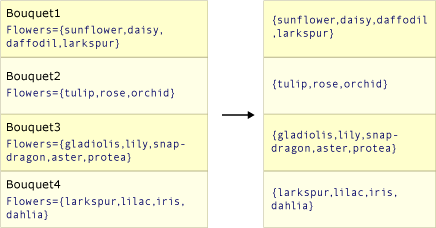
This illustration depicts how SelectMany concatenates the intermediate sequence of arrays into one final result value that contains each value from each intermediate array.
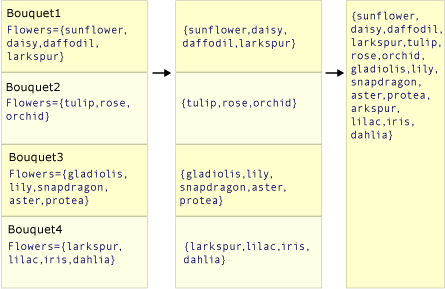
Code example
The following example compares the behavior of Select and SelectMany. The code creates a "bouquet" of flowers by taking the items from each list of flower names in the source collection. In the following example, the "single value" that the transform function System.Linq.Enumerable.Select%28System.Collections.Generic.IEnumerable%7B%7D%2CSystem.Func%7B%2C%7D%29 uses is a collection of values. This example requires the extra foreach loop in order to enumerate each string in each subsequence.
sampledocs/csharp/linq/standard-query-operators/snippets/standard-query-operators/SelectProjectionExamples.csSelectVsSelectMany
using System.Text;

namespace StandardQueryOperators;
internal class SelectProjectionExamples
{
    public static void RunAllSnippets()
    {
        SelectSimpleQuerySyntax();
        SelectSimpleMethodSyntax();
        SelectManyQuerySyntax();
        SelectManyMethodSyntax();
        NumbersAndLetters();
        SelectVsSelectMany();
    }

    private static void SelectSimpleQuerySyntax()
    {
        // <SelectSimpleQuery>
        List<string> words = ["an", "apple", "a", "day"];

        var query = from word in words
                    select word.Substring(0, 1);

        foreach (string s in query)
        {
            Console.WriteLine(s);
        }

        /* This code produces the following output:

            a
            a
            a
            d
        */
        // </SelectSimpleQuery>
    }

    private static void SelectSimpleMethodSyntax()
    {
        // <SelectSimpleMethod>
        List<string> words = ["an", "apple", "a", "day"];

        var query = words.Select(word => word.Substring(0, 1));

        foreach (string s in query)
        {
            Console.WriteLine(s);
        }

        /* This code produces the following output:

            a
            a
            a
            d
        */
        // </SelectSimpleMethod>
    }
    private static void SelectManyQuerySyntax()
    {
        // <SelectManyQuery>
        List<string> phrases = ["an apple a day", "the quick brown fox"];

        var query = from phrase in phrases
                    from word in phrase.Split(' ')
                    select word;

        foreach (string s in query)
        {
            Console.WriteLine(s);
        }

        /* This code produces the following output:

            an
            apple
            a
            day
            the
            quick
            brown
            fox
        */
        // </SelectManyQuery>
    }

    private static void SelectManyMethodSyntax()
    {
        // <SelectManyMethod>
        List<string> phrases = ["an apple a day", "the quick brown fox"];

        var query = phrases.SelectMany(phrase => phrase.Split(' '));

        foreach (string s in query)
        {
            Console.WriteLine(s);
        }

        /* This code produces the following output:

            an
            apple
            a
            day
            the
            quick
            brown
            fox
        */
        // </SelectManyMethod>
    }
    private static void NumbersAndLetters()
    {
        Console.OutputEncoding = Encoding.UTF8;

        // <NumbersAndLetters>
        // An int array with 7 elements.
        IEnumerable<int> numbers = [1, 2, 3, 4, 5, 6, 7];
        // A char array with 6 elements.
        IEnumerable<char> letters = ['A', 'B', 'C', 'D', 'E', 'F'];
        // </NumbersAndLetters>

        // <Emoji>
        // A string array with 8 elements.
        IEnumerable<string> emoji = [ "🤓", "🔥", "🎉", "👀", "⭐", "💜", "✔", "💯"];
        // </Emoji>

        // <SelectManyQuery2>
        var query = from number in numbers
                    from letter in letters
                    select (number, letter);

        foreach (var item in query)
        {
            Console.WriteLine(item);
        }
        // </SelectManyQuery2>

        // <SelectManyMethod2>
        var method = numbers
            .SelectMany(number => letters,
            (number, letter) => (number, letter));

        foreach (var item in method)
        {
            Console.WriteLine(item);
        }
        // </SelectManyMethod2>

        ZipTupleExample(numbers, letters);
        ZipTripleExample(numbers, letters, emoji);
        ZipResultExample(numbers, letters);
    }

    private static void ZipTupleExample(
        IEnumerable<int> numbers,
        IEnumerable<char> letters)
    {
        Console.WriteLine("Zip (TFirst, TSecond):");

        // <ZipTuple>
        foreach ((int number, char letter) in numbers.Zip(letters))
        {
            Console.WriteLine($"Number: {number} zipped with letter: '{letter}'");
        }
        // This code produces the following output:
        //     Number: 1 zipped with letter: 'A'
        //     Number: 2 zipped with letter: 'B'
        //     Number: 3 zipped with letter: 'C'
        //     Number: 4 zipped with letter: 'D'
        //     Number: 5 zipped with letter: 'E'
        //     Number: 6 zipped with letter: 'F'
        // </ZipTuple>

        Console.WriteLine();
    }

    private static void ZipResultExample(
        IEnumerable<int> numbers,
        IEnumerable<char> letters)
    {
        Console.WriteLine("Zip (TFirst, TSecond, Func<TFirst, TSecond, TResult>):");

        // <ZipResultSelector>
        foreach (string result in
            numbers.Zip(letters, (number, letter) => $"{number} = {letter} ({(int)letter})"))
        {
            Console.WriteLine(result);
        }
        // This code produces the following output:
        //     1 = A (65)
        //     2 = B (66)
        //     3 = C (67)
        //     4 = D (68)
        //     5 = E (69)
        //     6 = F (70)
        // </ZipResultSelector>

        Console.WriteLine();
    }

    private static void ZipTripleExample(
        IEnumerable<int> numbers,
        IEnumerable<char> letters,
        IEnumerable<string> emoji)
    {
        Console.WriteLine("Zip (TFirst, TSecond, TThird):");

        // <ZipTriple>
        foreach ((int number, char letter, string em) in numbers.Zip(letters, emoji))
        {
            Console.WriteLine(
                $"Number: {number} is zipped with letter: '{letter}' and emoji: {em}");
        }
        // This code produces the following output:
        //     Number: 1 is zipped with letter: 'A' and emoji: 🤓
        //     Number: 2 is zipped with letter: 'B' and emoji: 🔥
        //     Number: 3 is zipped with letter: 'C' and emoji: 🎉
        //     Number: 4 is zipped with letter: 'D' and emoji: 👀
        //     Number: 5 is zipped with letter: 'E' and emoji: ⭐
        //     Number: 6 is zipped with letter: 'F' and emoji: 💜
        // </ZipTriple>

        Console.WriteLine();
    }

    // <SelectVsSelectMany>
    class Bouquet
    {
        public required List<string> Flowers { get; init; }
    }

    static void SelectVsSelectMany()
    {
        List<Bouquet> bouquets =
        [
            new Bouquet { Flowers = ["sunflower", "daisy", "daffodil", "larkspur"] },
            new Bouquet { Flowers = ["tulip", "rose", "orchid"] },
            new Bouquet { Flowers = ["gladiolis", "lily", "snapdragon", "aster", "protea"] },
            new Bouquet { Flowers = ["larkspur", "lilac", "iris", "dahlia"] }
        ];

        IEnumerable<List<string>> query1 = bouquets.Select(bq => bq.Flowers);

        IEnumerable<string> query2 = bouquets.SelectMany(bq => bq.Flowers);

        Console.WriteLine("Results by using Select():");
        // Note the extra foreach loop here.
        foreach (IEnumerable<string> collection in query1)
        {
            foreach (string item in collection)
            {
                Console.WriteLine(item);
            }
        }

        Console.WriteLine("\nResults by using SelectMany():");
        foreach (string item in query2)
        {
            Console.WriteLine(item);
        }
    }
    // </SelectVsSelectMany>
}