Boxing is the process of converting a value type to the type object or to any interface type implemented by this value type. When the common language runtime (CLR) boxes a value type, it wraps the value inside a System.Object instance and stores it on the managed heap. Unboxing extracts the value type from the object. Boxing is implicit; unboxing is explicit. The concept of boxing and unboxing underlies the C# unified view of the type system in which a value of any type can be treated as an object.
In the following example, the integer variable i is boxed and assigned to object o.
sample · csharpsamples/snippets/csharp/VS_Snippets_VBCSharp/CsProgGuideTypes/CS/Class1.cs14
//<snippet5555>
using System;
using System.Collections.Generic;
//</snippet5555>

namespace CsProgGuideTypes
{
    //-------------------------------------------------------------------------
    class BoxingAndUnboxing
    {
        static void Main()
        {
            //<Snippet14>
            int i = 123;
            // The following line boxes i.
            object o = i;
            //</Snippet14>

            //<Snippet15>
            o = 123;
            i = (int)o;  // unboxing
            //</Snippet15>

            //<Snippet47>
            // String.Concat example.
            // String.Concat has many versions. Rest the mouse pointer on
            // Concat in the following statement to verify that the version
            // that is used here takes three object arguments. Both 42 and
            // true must be boxed.
            Console.WriteLine(String.Concat("Answer", 42, true));

            // List example.
            // Create a list of objects to hold a heterogeneous collection
            // of elements.
            List<object> mixedList = [];

            // Add a string element to the list.
            mixedList.Add("First Group:");

            // Add some integers to the list.
            for (int j = 1; j < 5; j++)
            {
                // Rest the mouse pointer over j to verify that you are adding
                // an int to a list of objects. Each element j is boxed when
                // you add j to mixedList.
                mixedList.Add(j);
            }

            // Add another string and more integers.
            mixedList.Add("Second Group:");
            for (int j = 5; j < 10; j++)
            {
                mixedList.Add(j);
            }

            // Display the elements in the list. Declare the loop variable by
            // using var, so that the compiler assigns its type.
            foreach (var item in mixedList)
            {
                // Rest the mouse pointer over item to verify that the elements
                // of mixedList are objects.
                Console.WriteLine(item);
            }

            // The following loop sums the squares of the first group of boxed
            // integers in mixedList. The list elements are objects, and cannot
            // be multiplied or added to the sum until they are unboxed. The
            // unboxing must be done explicitly.
            var sum = 0;
            for (var j = 1; j < 5; j++)
            {
                // The following statement causes a compiler error: Operator
                // '*' cannot be applied to operands of type 'object' and
                // 'object'.
                //sum += mixedList[j] * mixedList[j];

                // After the list elements are unboxed, the computation does
                // not cause a compiler error.
                sum += (int)mixedList[j] * (int)mixedList[j];
            }

            Console.WriteLine($"Sum: {sum}");

            // Output:
            // Answer42True
            // First Group:
            // 1
            // 2
            // 3
            // 4
            // Second Group:
            // 5
            // 6
            // 7
            // 8
            // 9
            // Sum: 30
            //</Snippet47>
        }

        static void Wrap()
        {
            //<Snippet21>
            int i = 123;      // a value type
            object o = i;     // boxing
            int j = (int)o;   // unboxing
            //</Snippet21>
        }
    }


    //-------------------------------------------------------------------------
    class BoxingValueCopy
    {
        static void Main()
        {
            //<Snippet16>
            // Create an int variable
            int i = 123;

            // Box the value type into an object reference
            object o = i;  // boxing

            // Display the initial values
            Console.WriteLine($"Value of i: {i}");
            Console.WriteLine($"Value of boxed object o: {o}");

            // Modify the original value type
            i = 456;

            // Display the values after modification
            Console.WriteLine("\nAfter changing i to 456:");
            Console.WriteLine($"Value of i: {i}");
            Console.WriteLine($"Value of boxed object o: {o}");

    		// Output:
    		// Value of i: 123
    		// Value of boxed object o: 123

    		// After changing i to 456:
    		// Value of i: 456
    		// Value of boxed object o: 123
            //</Snippet16>
        }
    }

    //-------------------------------------------------------------------------
    class TestBoxing
    {
        static void Main()
        {
            //<Snippet17>
            int i = 123;
            //</Snippet17>

            //<Snippet18>
            // Boxing copies the value of i into object o.
            object o = i;
            //</Snippet18>
        }
    }

    //-------------------------------------------------------------------------
    class WrapExplicitBoxing
    {
        static void Main()
        {
            //<Snippet19>
            int i = 123;
            object o = (object)i;  // explicit boxing
            //</Snippet19>
        }
    }

    //-------------------------------------------------------------------------
    //<Snippet20>
    class TestUnboxing
    {
        static void Main()
        {
            int i = 123;
            object o = i;  // implicit boxing

            try
            {
                int j = (short)o;  // attempt to unbox

                Console.WriteLine("Unboxing OK.");
            }
            catch (InvalidCastException e)
            {
                Console.WriteLine($"{e.Message} Error: Incorrect unboxing.");
            }
        }
    }
    //</Snippet20>

    //-------------------------------------------------------------------------
    public class ConvertByteArrayExample
    {
        static void Main(string[] args)
        {
            //<Snippet22>
            byte[] bytes = [0, 0, 0, 25];

            // If the system architecture is little-endian (that is, little end first),
            // reverse the byte array.
            if (BitConverter.IsLittleEndian)
                Array.Reverse(bytes);

            int i = BitConverter.ToInt32(bytes, 0);
            Console.WriteLine($"int: {i}");
            // Output: int: 25
            //</Snippet22>
        }
    }

    //-------------------------------------------------------------------------
    public class ConvertByteArrayExample2
    {
        static void Main(string[] args)
        {
            //<Snippet23>
            byte[] bytes = BitConverter.GetBytes(201805978);
            Console.WriteLine($"byte array: {BitConverter.ToString(bytes)}");
            // Output: byte array: 9A-50-07-0C
            //</Snippet23>
        }
    }

    //-------------------------------------------------------------------------
    public class ConvertHexadecimalStrings
    {
        static void Main(string[] args)
        {
            //<Snippet30>
            string input = "Hello World!";
            char[] values = input.ToCharArray();
            foreach (char letter in values)
            {
                // Get the integral value of the character.
                int value = Convert.ToInt32(letter);
                // Convert the integer value to a hexadecimal value in string form.
                Console.WriteLine($"Hexadecimal value of {letter} is {value:X}");
            }
            /* Output:
                Hexadecimal value of H is 48
                Hexadecimal value of e is 65
                Hexadecimal value of l is 6C
                Hexadecimal value of l is 6C
                Hexadecimal value of o is 6F
                Hexadecimal value of   is 20
                Hexadecimal value of W is 57
                Hexadecimal value of o is 6F
                Hexadecimal value of r is 72
                Hexadecimal value of l is 6C
                Hexadecimal value of d is 64
                Hexadecimal value of ! is 21
             */
            //</Snippet30>

            //<Snippet31>
            string hexValues = "48 65 6C 6C 6F 20 57 6F 72 6C 64 21";
            string[] hexValuesSplit = hexValues.Split(' ');
            foreach (string hex in hexValuesSplit)
            {
                // Convert the number expressed in base-16 to an integer.
                int value = Convert.ToInt32(hex, 16);
                // Get the character corresponding to the integral value.
                string stringValue = char.ConvertFromUtf32(value);
                char charValue = (char)value;
                Console.WriteLine("hexadecimal value = {0}, int value = {1}, char value = {2} or {3}",
                                    hex, value, stringValue, charValue);
            }
            /* Output:
                hexadecimal value = 48, int value = 72, char value = H or H
                hexadecimal value = 65, int value = 101, char value = e or e
                hexadecimal value = 6C, int value = 108, char value = l or l
                hexadecimal value = 6C, int value = 108, char value = l or l
                hexadecimal value = 6F, int value = 111, char value = o or o
                hexadecimal value = 20, int value = 32, char value =   or
                hexadecimal value = 57, int value = 87, char value = W or W
                hexadecimal value = 6F, int value = 111, char value = o or o
                hexadecimal value = 72, int value = 114, char value = r or r
                hexadecimal value = 6C, int value = 108, char value = l or l
                hexadecimal value = 64, int value = 100, char value = d or d
                hexadecimal value = 21, int value = 33, char value = ! or !
            */
            //</Snippet31>

            //<Snippet32>
            string hexString = "8E2";
            int num = int.Parse(hexString, System.Globalization.NumberStyles.HexNumber);
            Console.WriteLine(num);
            //Output: 2274
            //</Snippet32>

            //see also snippet38 below
        }
    }

    class ConvertHexStrings2
    {
        static void Main()
        {
            //<snippet38>
            byte[] vals = [0x01, 0xAA, 0xB1, 0xDC, 0x10, 0xDD];

            string str = BitConverter.ToString(vals);
            Console.WriteLine(str);

            str = BitConverter.ToString(vals).Replace("-", "");
            Console.WriteLine(str);

            /*Output:
              01-AA-B1-DC-10-DD
              01AAB1DC10DD
             */
            //</snippet38>

            //<snippet39>

            string hexString = "43480170";
            uint num = uint.Parse(hexString, System.Globalization.NumberStyles.AllowHexSpecifier);

            byte[] floatVals = BitConverter.GetBytes(num);
            float f = BitConverter.ToSingle(floatVals, 0);
            Console.WriteLine($"float convert = {f}");

            // Output: 200.0056
            //</snippet39>

            //<snippet48>
            byte[] array = [0x64, 0x6f, 0x74, 0x63, 0x65, 0x74];

            string hexValue = Convert.ToHexString(array);
            Console.WriteLine(hexValue);

            /*Output:
              646F74636574
             */
            //</snippet48>
            // Keep the console window open in debug mode.
            System.Console.WriteLine("Press any key to exit.");
            System.Console.ReadKey();
        }
    }
}
The object o can then be unboxed and assigned to integer variable i:
sample · csharpsamples/snippets/csharp/VS_Snippets_VBCSharp/CsProgGuideTypes/CS/Class1.cs15
//<snippet5555>
using System;
using System.Collections.Generic;
//</snippet5555>

namespace CsProgGuideTypes
{
    //-------------------------------------------------------------------------
    class BoxingAndUnboxing
    {
        static void Main()
        {
            //<Snippet14>
            int i = 123;
            // The following line boxes i.
            object o = i;
            //</Snippet14>

            //<Snippet15>
            o = 123;
            i = (int)o;  // unboxing
            //</Snippet15>

            //<Snippet47>
            // String.Concat example.
            // String.Concat has many versions. Rest the mouse pointer on
            // Concat in the following statement to verify that the version
            // that is used here takes three object arguments. Both 42 and
            // true must be boxed.
            Console.WriteLine(String.Concat("Answer", 42, true));

            // List example.
            // Create a list of objects to hold a heterogeneous collection
            // of elements.
            List<object> mixedList = [];

            // Add a string element to the list.
            mixedList.Add("First Group:");

            // Add some integers to the list.
            for (int j = 1; j < 5; j++)
            {
                // Rest the mouse pointer over j to verify that you are adding
                // an int to a list of objects. Each element j is boxed when
                // you add j to mixedList.
                mixedList.Add(j);
            }

            // Add another string and more integers.
            mixedList.Add("Second Group:");
            for (int j = 5; j < 10; j++)
            {
                mixedList.Add(j);
            }

            // Display the elements in the list. Declare the loop variable by
            // using var, so that the compiler assigns its type.
            foreach (var item in mixedList)
            {
                // Rest the mouse pointer over item to verify that the elements
                // of mixedList are objects.
                Console.WriteLine(item);
            }

            // The following loop sums the squares of the first group of boxed
            // integers in mixedList. The list elements are objects, and cannot
            // be multiplied or added to the sum until they are unboxed. The
            // unboxing must be done explicitly.
            var sum = 0;
            for (var j = 1; j < 5; j++)
            {
                // The following statement causes a compiler error: Operator
                // '*' cannot be applied to operands of type 'object' and
                // 'object'.
                //sum += mixedList[j] * mixedList[j];

                // After the list elements are unboxed, the computation does
                // not cause a compiler error.
                sum += (int)mixedList[j] * (int)mixedList[j];
            }

            Console.WriteLine($"Sum: {sum}");

            // Output:
            // Answer42True
            // First Group:
            // 1
            // 2
            // 3
            // 4
            // Second Group:
            // 5
            // 6
            // 7
            // 8
            // 9
            // Sum: 30
            //</Snippet47>
        }

        static void Wrap()
        {
            //<Snippet21>
            int i = 123;      // a value type
            object o = i;     // boxing
            int j = (int)o;   // unboxing
            //</Snippet21>
        }
    }


    //-------------------------------------------------------------------------
    class BoxingValueCopy
    {
        static void Main()
        {
            //<Snippet16>
            // Create an int variable
            int i = 123;

            // Box the value type into an object reference
            object o = i;  // boxing

            // Display the initial values
            Console.WriteLine($"Value of i: {i}");
            Console.WriteLine($"Value of boxed object o: {o}");

            // Modify the original value type
            i = 456;

            // Display the values after modification
            Console.WriteLine("\nAfter changing i to 456:");
            Console.WriteLine($"Value of i: {i}");
            Console.WriteLine($"Value of boxed object o: {o}");

    		// Output:
    		// Value of i: 123
    		// Value of boxed object o: 123

    		// After changing i to 456:
    		// Value of i: 456
    		// Value of boxed object o: 123
            //</Snippet16>
        }
    }

    //-------------------------------------------------------------------------
    class TestBoxing
    {
        static void Main()
        {
            //<Snippet17>
            int i = 123;
            //</Snippet17>

            //<Snippet18>
            // Boxing copies the value of i into object o.
            object o = i;
            //</Snippet18>
        }
    }

    //-------------------------------------------------------------------------
    class WrapExplicitBoxing
    {
        static void Main()
        {
            //<Snippet19>
            int i = 123;
            object o = (object)i;  // explicit boxing
            //</Snippet19>
        }
    }

    //-------------------------------------------------------------------------
    //<Snippet20>
    class TestUnboxing
    {
        static void Main()
        {
            int i = 123;
            object o = i;  // implicit boxing

            try
            {
                int j = (short)o;  // attempt to unbox

                Console.WriteLine("Unboxing OK.");
            }
            catch (InvalidCastException e)
            {
                Console.WriteLine($"{e.Message} Error: Incorrect unboxing.");
            }
        }
    }
    //</Snippet20>

    //-------------------------------------------------------------------------
    public class ConvertByteArrayExample
    {
        static void Main(string[] args)
        {
            //<Snippet22>
            byte[] bytes = [0, 0, 0, 25];

            // If the system architecture is little-endian (that is, little end first),
            // reverse the byte array.
            if (BitConverter.IsLittleEndian)
                Array.Reverse(bytes);

            int i = BitConverter.ToInt32(bytes, 0);
            Console.WriteLine($"int: {i}");
            // Output: int: 25
            //</Snippet22>
        }
    }

    //-------------------------------------------------------------------------
    public class ConvertByteArrayExample2
    {
        static void Main(string[] args)
        {
            //<Snippet23>
            byte[] bytes = BitConverter.GetBytes(201805978);
            Console.WriteLine($"byte array: {BitConverter.ToString(bytes)}");
            // Output: byte array: 9A-50-07-0C
            //</Snippet23>
        }
    }

    //-------------------------------------------------------------------------
    public class ConvertHexadecimalStrings
    {
        static void Main(string[] args)
        {
            //<Snippet30>
            string input = "Hello World!";
            char[] values = input.ToCharArray();
            foreach (char letter in values)
            {
                // Get the integral value of the character.
                int value = Convert.ToInt32(letter);
                // Convert the integer value to a hexadecimal value in string form.
                Console.WriteLine($"Hexadecimal value of {letter} is {value:X}");
            }
            /* Output:
                Hexadecimal value of H is 48
                Hexadecimal value of e is 65
                Hexadecimal value of l is 6C
                Hexadecimal value of l is 6C
                Hexadecimal value of o is 6F
                Hexadecimal value of   is 20
                Hexadecimal value of W is 57
                Hexadecimal value of o is 6F
                Hexadecimal value of r is 72
                Hexadecimal value of l is 6C
                Hexadecimal value of d is 64
                Hexadecimal value of ! is 21
             */
            //</Snippet30>

            //<Snippet31>
            string hexValues = "48 65 6C 6C 6F 20 57 6F 72 6C 64 21";
            string[] hexValuesSplit = hexValues.Split(' ');
            foreach (string hex in hexValuesSplit)
            {
                // Convert the number expressed in base-16 to an integer.
                int value = Convert.ToInt32(hex, 16);
                // Get the character corresponding to the integral value.
                string stringValue = char.ConvertFromUtf32(value);
                char charValue = (char)value;
                Console.WriteLine("hexadecimal value = {0}, int value = {1}, char value = {2} or {3}",
                                    hex, value, stringValue, charValue);
            }
            /* Output:
                hexadecimal value = 48, int value = 72, char value = H or H
                hexadecimal value = 65, int value = 101, char value = e or e
                hexadecimal value = 6C, int value = 108, char value = l or l
                hexadecimal value = 6C, int value = 108, char value = l or l
                hexadecimal value = 6F, int value = 111, char value = o or o
                hexadecimal value = 20, int value = 32, char value =   or
                hexadecimal value = 57, int value = 87, char value = W or W
                hexadecimal value = 6F, int value = 111, char value = o or o
                hexadecimal value = 72, int value = 114, char value = r or r
                hexadecimal value = 6C, int value = 108, char value = l or l
                hexadecimal value = 64, int value = 100, char value = d or d
                hexadecimal value = 21, int value = 33, char value = ! or !
            */
            //</Snippet31>

            //<Snippet32>
            string hexString = "8E2";
            int num = int.Parse(hexString, System.Globalization.NumberStyles.HexNumber);
            Console.WriteLine(num);
            //Output: 2274
            //</Snippet32>

            //see also snippet38 below
        }
    }

    class ConvertHexStrings2
    {
        static void Main()
        {
            //<snippet38>
            byte[] vals = [0x01, 0xAA, 0xB1, 0xDC, 0x10, 0xDD];

            string str = BitConverter.ToString(vals);
            Console.WriteLine(str);

            str = BitConverter.ToString(vals).Replace("-", "");
            Console.WriteLine(str);

            /*Output:
              01-AA-B1-DC-10-DD
              01AAB1DC10DD
             */
            //</snippet38>

            //<snippet39>

            string hexString = "43480170";
            uint num = uint.Parse(hexString, System.Globalization.NumberStyles.AllowHexSpecifier);

            byte[] floatVals = BitConverter.GetBytes(num);
            float f = BitConverter.ToSingle(floatVals, 0);
            Console.WriteLine($"float convert = {f}");

            // Output: 200.0056
            //</snippet39>

            //<snippet48>
            byte[] array = [0x64, 0x6f, 0x74, 0x63, 0x65, 0x74];

            string hexValue = Convert.ToHexString(array);
            Console.WriteLine(hexValue);

            /*Output:
              646F74636574
             */
            //</snippet48>
            // Keep the console window open in debug mode.
            System.Console.WriteLine("Press any key to exit.");
            System.Console.ReadKey();
        }
    }
}
The following examples illustrate how boxing is used in C#.
sample · csharpsamples/snippets/csharp/VS_Snippets_VBCSharp/CsProgGuideTypes/CS/Class1.cs47
//<snippet5555>
using System;
using System.Collections.Generic;
//</snippet5555>

namespace CsProgGuideTypes
{
    //-------------------------------------------------------------------------
    class BoxingAndUnboxing
    {
        static void Main()
        {
            //<Snippet14>
            int i = 123;
            // The following line boxes i.
            object o = i;
            //</Snippet14>

            //<Snippet15>
            o = 123;
            i = (int)o;  // unboxing
            //</Snippet15>

            //<Snippet47>
            // String.Concat example.
            // String.Concat has many versions. Rest the mouse pointer on
            // Concat in the following statement to verify that the version
            // that is used here takes three object arguments. Both 42 and
            // true must be boxed.
            Console.WriteLine(String.Concat("Answer", 42, true));

            // List example.
            // Create a list of objects to hold a heterogeneous collection
            // of elements.
            List<object> mixedList = [];

            // Add a string element to the list.
            mixedList.Add("First Group:");

            // Add some integers to the list.
            for (int j = 1; j < 5; j++)
            {
                // Rest the mouse pointer over j to verify that you are adding
                // an int to a list of objects. Each element j is boxed when
                // you add j to mixedList.
                mixedList.Add(j);
            }

            // Add another string and more integers.
            mixedList.Add("Second Group:");
            for (int j = 5; j < 10; j++)
            {
                mixedList.Add(j);
            }

            // Display the elements in the list. Declare the loop variable by
            // using var, so that the compiler assigns its type.
            foreach (var item in mixedList)
            {
                // Rest the mouse pointer over item to verify that the elements
                // of mixedList are objects.
                Console.WriteLine(item);
            }

            // The following loop sums the squares of the first group of boxed
            // integers in mixedList. The list elements are objects, and cannot
            // be multiplied or added to the sum until they are unboxed. The
            // unboxing must be done explicitly.
            var sum = 0;
            for (var j = 1; j < 5; j++)
            {
                // The following statement causes a compiler error: Operator
                // '*' cannot be applied to operands of type 'object' and
                // 'object'.
                //sum += mixedList[j] * mixedList[j];

                // After the list elements are unboxed, the computation does
                // not cause a compiler error.
                sum += (int)mixedList[j] * (int)mixedList[j];
            }

            Console.WriteLine($"Sum: {sum}");

            // Output:
            // Answer42True
            // First Group:
            // 1
            // 2
            // 3
            // 4
            // Second Group:
            // 5
            // 6
            // 7
            // 8
            // 9
            // Sum: 30
            //</Snippet47>
        }

        static void Wrap()
        {
            //<Snippet21>
            int i = 123;      // a value type
            object o = i;     // boxing
            int j = (int)o;   // unboxing
            //</Snippet21>
        }
    }


    //-------------------------------------------------------------------------
    class BoxingValueCopy
    {
        static void Main()
        {
            //<Snippet16>
            // Create an int variable
            int i = 123;

            // Box the value type into an object reference
            object o = i;  // boxing

            // Display the initial values
            Console.WriteLine($"Value of i: {i}");
            Console.WriteLine($"Value of boxed object o: {o}");

            // Modify the original value type
            i = 456;

            // Display the values after modification
            Console.WriteLine("\nAfter changing i to 456:");
            Console.WriteLine($"Value of i: {i}");
            Console.WriteLine($"Value of boxed object o: {o}");

    		// Output:
    		// Value of i: 123
    		// Value of boxed object o: 123

    		// After changing i to 456:
    		// Value of i: 456
    		// Value of boxed object o: 123
            //</Snippet16>
        }
    }

    //-------------------------------------------------------------------------
    class TestBoxing
    {
        static void Main()
        {
            //<Snippet17>
            int i = 123;
            //</Snippet17>

            //<Snippet18>
            // Boxing copies the value of i into object o.
            object o = i;
            //</Snippet18>
        }
    }

    //-------------------------------------------------------------------------
    class WrapExplicitBoxing
    {
        static void Main()
        {
            //<Snippet19>
            int i = 123;
            object o = (object)i;  // explicit boxing
            //</Snippet19>
        }
    }

    //-------------------------------------------------------------------------
    //<Snippet20>
    class TestUnboxing
    {
        static void Main()
        {
            int i = 123;
            object o = i;  // implicit boxing

            try
            {
                int j = (short)o;  // attempt to unbox

                Console.WriteLine("Unboxing OK.");
            }
            catch (InvalidCastException e)
            {
                Console.WriteLine($"{e.Message} Error: Incorrect unboxing.");
            }
        }
    }
    //</Snippet20>

    //-------------------------------------------------------------------------
    public class ConvertByteArrayExample
    {
        static void Main(string[] args)
        {
            //<Snippet22>
            byte[] bytes = [0, 0, 0, 25];

            // If the system architecture is little-endian (that is, little end first),
            // reverse the byte array.
            if (BitConverter.IsLittleEndian)
                Array.Reverse(bytes);

            int i = BitConverter.ToInt32(bytes, 0);
            Console.WriteLine($"int: {i}");
            // Output: int: 25
            //</Snippet22>
        }
    }

    //-------------------------------------------------------------------------
    public class ConvertByteArrayExample2
    {
        static void Main(string[] args)
        {
            //<Snippet23>
            byte[] bytes = BitConverter.GetBytes(201805978);
            Console.WriteLine($"byte array: {BitConverter.ToString(bytes)}");
            // Output: byte array: 9A-50-07-0C
            //</Snippet23>
        }
    }

    //-------------------------------------------------------------------------
    public class ConvertHexadecimalStrings
    {
        static void Main(string[] args)
        {
            //<Snippet30>
            string input = "Hello World!";
            char[] values = input.ToCharArray();
            foreach (char letter in values)
            {
                // Get the integral value of the character.
                int value = Convert.ToInt32(letter);
                // Convert the integer value to a hexadecimal value in string form.
                Console.WriteLine($"Hexadecimal value of {letter} is {value:X}");
            }
            /* Output:
                Hexadecimal value of H is 48
                Hexadecimal value of e is 65
                Hexadecimal value of l is 6C
                Hexadecimal value of l is 6C
                Hexadecimal value of o is 6F
                Hexadecimal value of   is 20
                Hexadecimal value of W is 57
                Hexadecimal value of o is 6F
                Hexadecimal value of r is 72
                Hexadecimal value of l is 6C
                Hexadecimal value of d is 64
                Hexadecimal value of ! is 21
             */
            //</Snippet30>

            //<Snippet31>
            string hexValues = "48 65 6C 6C 6F 20 57 6F 72 6C 64 21";
            string[] hexValuesSplit = hexValues.Split(' ');
            foreach (string hex in hexValuesSplit)
            {
                // Convert the number expressed in base-16 to an integer.
                int value = Convert.ToInt32(hex, 16);
                // Get the character corresponding to the integral value.
                string stringValue = char.ConvertFromUtf32(value);
                char charValue = (char)value;
                Console.WriteLine("hexadecimal value = {0}, int value = {1}, char value = {2} or {3}",
                                    hex, value, stringValue, charValue);
            }
            /* Output:
                hexadecimal value = 48, int value = 72, char value = H or H
                hexadecimal value = 65, int value = 101, char value = e or e
                hexadecimal value = 6C, int value = 108, char value = l or l
                hexadecimal value = 6C, int value = 108, char value = l or l
                hexadecimal value = 6F, int value = 111, char value = o or o
                hexadecimal value = 20, int value = 32, char value =   or
                hexadecimal value = 57, int value = 87, char value = W or W
                hexadecimal value = 6F, int value = 111, char value = o or o
                hexadecimal value = 72, int value = 114, char value = r or r
                hexadecimal value = 6C, int value = 108, char value = l or l
                hexadecimal value = 64, int value = 100, char value = d or d
                hexadecimal value = 21, int value = 33, char value = ! or !
            */
            //</Snippet31>

            //<Snippet32>
            string hexString = "8E2";
            int num = int.Parse(hexString, System.Globalization.NumberStyles.HexNumber);
            Console.WriteLine(num);
            //Output: 2274
            //</Snippet32>

            //see also snippet38 below
        }
    }

    class ConvertHexStrings2
    {
        static void Main()
        {
            //<snippet38>
            byte[] vals = [0x01, 0xAA, 0xB1, 0xDC, 0x10, 0xDD];

            string str = BitConverter.ToString(vals);
            Console.WriteLine(str);

            str = BitConverter.ToString(vals).Replace("-", "");
            Console.WriteLine(str);

            /*Output:
              01-AA-B1-DC-10-DD
              01AAB1DC10DD
             */
            //</snippet38>

            //<snippet39>

            string hexString = "43480170";
            uint num = uint.Parse(hexString, System.Globalization.NumberStyles.AllowHexSpecifier);

            byte[] floatVals = BitConverter.GetBytes(num);
            float f = BitConverter.ToSingle(floatVals, 0);
            Console.WriteLine($"float convert = {f}");

            // Output: 200.0056
            //</snippet39>

            //<snippet48>
            byte[] array = [0x64, 0x6f, 0x74, 0x63, 0x65, 0x74];

            string hexValue = Convert.ToHexString(array);
            Console.WriteLine(hexValue);

            /*Output:
              646F74636574
             */
            //</snippet48>
            // Keep the console window open in debug mode.
            System.Console.WriteLine("Press any key to exit.");
            System.Console.ReadKey();
        }
    }
}Performance
In relation to simple assignments, boxing and unboxing are computationally expensive processes. When a value type is boxed, a new object must be allocated and constructed. To a lesser degree, the cast required for unboxing is also expensive computationally. For more information, see Performance.
Boxing
Boxing is used to store value types in the garbage-collected heap. Boxing is an implicit conversion of a value type to the type object or to any interface type implemented by this value type. Boxing a value type allocates an object instance on the heap and copies the value into the new object.
Consider the following declaration of a value-type variable:
sample · csharpsamples/snippets/csharp/VS_Snippets_VBCSharp/CsProgGuideTypes/CS/Class1.cs17
//<snippet5555>
using System;
using System.Collections.Generic;
//</snippet5555>

namespace CsProgGuideTypes
{
    //-------------------------------------------------------------------------
    class BoxingAndUnboxing
    {
        static void Main()
        {
            //<Snippet14>
            int i = 123;
            // The following line boxes i.
            object o = i;
            //</Snippet14>

            //<Snippet15>
            o = 123;
            i = (int)o;  // unboxing
            //</Snippet15>

            //<Snippet47>
            // String.Concat example.
            // String.Concat has many versions. Rest the mouse pointer on
            // Concat in the following statement to verify that the version
            // that is used here takes three object arguments. Both 42 and
            // true must be boxed.
            Console.WriteLine(String.Concat("Answer", 42, true));

            // List example.
            // Create a list of objects to hold a heterogeneous collection
            // of elements.
            List<object> mixedList = [];

            // Add a string element to the list.
            mixedList.Add("First Group:");

            // Add some integers to the list.
            for (int j = 1; j < 5; j++)
            {
                // Rest the mouse pointer over j to verify that you are adding
                // an int to a list of objects. Each element j is boxed when
                // you add j to mixedList.
                mixedList.Add(j);
            }

            // Add another string and more integers.
            mixedList.Add("Second Group:");
            for (int j = 5; j < 10; j++)
            {
                mixedList.Add(j);
            }

            // Display the elements in the list. Declare the loop variable by
            // using var, so that the compiler assigns its type.
            foreach (var item in mixedList)
            {
                // Rest the mouse pointer over item to verify that the elements
                // of mixedList are objects.
                Console.WriteLine(item);
            }

            // The following loop sums the squares of the first group of boxed
            // integers in mixedList. The list elements are objects, and cannot
            // be multiplied or added to the sum until they are unboxed. The
            // unboxing must be done explicitly.
            var sum = 0;
            for (var j = 1; j < 5; j++)
            {
                // The following statement causes a compiler error: Operator
                // '*' cannot be applied to operands of type 'object' and
                // 'object'.
                //sum += mixedList[j] * mixedList[j];

                // After the list elements are unboxed, the computation does
                // not cause a compiler error.
                sum += (int)mixedList[j] * (int)mixedList[j];
            }

            Console.WriteLine($"Sum: {sum}");

            // Output:
            // Answer42True
            // First Group:
            // 1
            // 2
            // 3
            // 4
            // Second Group:
            // 5
            // 6
            // 7
            // 8
            // 9
            // Sum: 30
            //</Snippet47>
        }

        static void Wrap()
        {
            //<Snippet21>
            int i = 123;      // a value type
            object o = i;     // boxing
            int j = (int)o;   // unboxing
            //</Snippet21>
        }
    }


    //-------------------------------------------------------------------------
    class BoxingValueCopy
    {
        static void Main()
        {
            //<Snippet16>
            // Create an int variable
            int i = 123;

            // Box the value type into an object reference
            object o = i;  // boxing

            // Display the initial values
            Console.WriteLine($"Value of i: {i}");
            Console.WriteLine($"Value of boxed object o: {o}");

            // Modify the original value type
            i = 456;

            // Display the values after modification
            Console.WriteLine("\nAfter changing i to 456:");
            Console.WriteLine($"Value of i: {i}");
            Console.WriteLine($"Value of boxed object o: {o}");

    		// Output:
    		// Value of i: 123
    		// Value of boxed object o: 123

    		// After changing i to 456:
    		// Value of i: 456
    		// Value of boxed object o: 123
            //</Snippet16>
        }
    }

    //-------------------------------------------------------------------------
    class TestBoxing
    {
        static void Main()
        {
            //<Snippet17>
            int i = 123;
            //</Snippet17>

            //<Snippet18>
            // Boxing copies the value of i into object o.
            object o = i;
            //</Snippet18>
        }
    }

    //-------------------------------------------------------------------------
    class WrapExplicitBoxing
    {
        static void Main()
        {
            //<Snippet19>
            int i = 123;
            object o = (object)i;  // explicit boxing
            //</Snippet19>
        }
    }

    //-------------------------------------------------------------------------
    //<Snippet20>
    class TestUnboxing
    {
        static void Main()
        {
            int i = 123;
            object o = i;  // implicit boxing

            try
            {
                int j = (short)o;  // attempt to unbox

                Console.WriteLine("Unboxing OK.");
            }
            catch (InvalidCastException e)
            {
                Console.WriteLine($"{e.Message} Error: Incorrect unboxing.");
            }
        }
    }
    //</Snippet20>

    //-------------------------------------------------------------------------
    public class ConvertByteArrayExample
    {
        static void Main(string[] args)
        {
            //<Snippet22>
            byte[] bytes = [0, 0, 0, 25];

            // If the system architecture is little-endian (that is, little end first),
            // reverse the byte array.
            if (BitConverter.IsLittleEndian)
                Array.Reverse(bytes);

            int i = BitConverter.ToInt32(bytes, 0);
            Console.WriteLine($"int: {i}");
            // Output: int: 25
            //</Snippet22>
        }
    }

    //-------------------------------------------------------------------------
    public class ConvertByteArrayExample2
    {
        static void Main(string[] args)
        {
            //<Snippet23>
            byte[] bytes = BitConverter.GetBytes(201805978);
            Console.WriteLine($"byte array: {BitConverter.ToString(bytes)}");
            // Output: byte array: 9A-50-07-0C
            //</Snippet23>
        }
    }

    //-------------------------------------------------------------------------
    public class ConvertHexadecimalStrings
    {
        static void Main(string[] args)
        {
            //<Snippet30>
            string input = "Hello World!";
            char[] values = input.ToCharArray();
            foreach (char letter in values)
            {
                // Get the integral value of the character.
                int value = Convert.ToInt32(letter);
                // Convert the integer value to a hexadecimal value in string form.
                Console.WriteLine($"Hexadecimal value of {letter} is {value:X}");
            }
            /* Output:
                Hexadecimal value of H is 48
                Hexadecimal value of e is 65
                Hexadecimal value of l is 6C
                Hexadecimal value of l is 6C
                Hexadecimal value of o is 6F
                Hexadecimal value of   is 20
                Hexadecimal value of W is 57
                Hexadecimal value of o is 6F
                Hexadecimal value of r is 72
                Hexadecimal value of l is 6C
                Hexadecimal value of d is 64
                Hexadecimal value of ! is 21
             */
            //</Snippet30>

            //<Snippet31>
            string hexValues = "48 65 6C 6C 6F 20 57 6F 72 6C 64 21";
            string[] hexValuesSplit = hexValues.Split(' ');
            foreach (string hex in hexValuesSplit)
            {
                // Convert the number expressed in base-16 to an integer.
                int value = Convert.ToInt32(hex, 16);
                // Get the character corresponding to the integral value.
                string stringValue = char.ConvertFromUtf32(value);
                char charValue = (char)value;
                Console.WriteLine("hexadecimal value = {0}, int value = {1}, char value = {2} or {3}",
                                    hex, value, stringValue, charValue);
            }
            /* Output:
                hexadecimal value = 48, int value = 72, char value = H or H
                hexadecimal value = 65, int value = 101, char value = e or e
                hexadecimal value = 6C, int value = 108, char value = l or l
                hexadecimal value = 6C, int value = 108, char value = l or l
                hexadecimal value = 6F, int value = 111, char value = o or o
                hexadecimal value = 20, int value = 32, char value =   or
                hexadecimal value = 57, int value = 87, char value = W or W
                hexadecimal value = 6F, int value = 111, char value = o or o
                hexadecimal value = 72, int value = 114, char value = r or r
                hexadecimal value = 6C, int value = 108, char value = l or l
                hexadecimal value = 64, int value = 100, char value = d or d
                hexadecimal value = 21, int value = 33, char value = ! or !
            */
            //</Snippet31>

            //<Snippet32>
            string hexString = "8E2";
            int num = int.Parse(hexString, System.Globalization.NumberStyles.HexNumber);
            Console.WriteLine(num);
            //Output: 2274
            //</Snippet32>

            //see also snippet38 below
        }
    }

    class ConvertHexStrings2
    {
        static void Main()
        {
            //<snippet38>
            byte[] vals = [0x01, 0xAA, 0xB1, 0xDC, 0x10, 0xDD];

            string str = BitConverter.ToString(vals);
            Console.WriteLine(str);

            str = BitConverter.ToString(vals).Replace("-", "");
            Console.WriteLine(str);

            /*Output:
              01-AA-B1-DC-10-DD
              01AAB1DC10DD
             */
            //</snippet38>

            //<snippet39>

            string hexString = "43480170";
            uint num = uint.Parse(hexString, System.Globalization.NumberStyles.AllowHexSpecifier);

            byte[] floatVals = BitConverter.GetBytes(num);
            float f = BitConverter.ToSingle(floatVals, 0);
            Console.WriteLine($"float convert = {f}");

            // Output: 200.0056
            //</snippet39>

            //<snippet48>
            byte[] array = [0x64, 0x6f, 0x74, 0x63, 0x65, 0x74];

            string hexValue = Convert.ToHexString(array);
            Console.WriteLine(hexValue);

            /*Output:
              646F74636574
             */
            //</snippet48>
            // Keep the console window open in debug mode.
            System.Console.WriteLine("Press any key to exit.");
            System.Console.ReadKey();
        }
    }
}
The following statement implicitly applies the boxing operation on the variable i:
sample · csharpsamples/snippets/csharp/VS_Snippets_VBCSharp/CsProgGuideTypes/CS/Class1.cs18
//<snippet5555>
using System;
using System.Collections.Generic;
//</snippet5555>

namespace CsProgGuideTypes
{
    //-------------------------------------------------------------------------
    class BoxingAndUnboxing
    {
        static void Main()
        {
            //<Snippet14>
            int i = 123;
            // The following line boxes i.
            object o = i;
            //</Snippet14>

            //<Snippet15>
            o = 123;
            i = (int)o;  // unboxing
            //</Snippet15>

            //<Snippet47>
            // String.Concat example.
            // String.Concat has many versions. Rest the mouse pointer on
            // Concat in the following statement to verify that the version
            // that is used here takes three object arguments. Both 42 and
            // true must be boxed.
            Console.WriteLine(String.Concat("Answer", 42, true));

            // List example.
            // Create a list of objects to hold a heterogeneous collection
            // of elements.
            List<object> mixedList = [];

            // Add a string element to the list.
            mixedList.Add("First Group:");

            // Add some integers to the list.
            for (int j = 1; j < 5; j++)
            {
                // Rest the mouse pointer over j to verify that you are adding
                // an int to a list of objects. Each element j is boxed when
                // you add j to mixedList.
                mixedList.Add(j);
            }

            // Add another string and more integers.
            mixedList.Add("Second Group:");
            for (int j = 5; j < 10; j++)
            {
                mixedList.Add(j);
            }

            // Display the elements in the list. Declare the loop variable by
            // using var, so that the compiler assigns its type.
            foreach (var item in mixedList)
            {
                // Rest the mouse pointer over item to verify that the elements
                // of mixedList are objects.
                Console.WriteLine(item);
            }

            // The following loop sums the squares of the first group of boxed
            // integers in mixedList. The list elements are objects, and cannot
            // be multiplied or added to the sum until they are unboxed. The
            // unboxing must be done explicitly.
            var sum = 0;
            for (var j = 1; j < 5; j++)
            {
                // The following statement causes a compiler error: Operator
                // '*' cannot be applied to operands of type 'object' and
                // 'object'.
                //sum += mixedList[j] * mixedList[j];

                // After the list elements are unboxed, the computation does
                // not cause a compiler error.
                sum += (int)mixedList[j] * (int)mixedList[j];
            }

            Console.WriteLine($"Sum: {sum}");

            // Output:
            // Answer42True
            // First Group:
            // 1
            // 2
            // 3
            // 4
            // Second Group:
            // 5
            // 6
            // 7
            // 8
            // 9
            // Sum: 30
            //</Snippet47>
        }

        static void Wrap()
        {
            //<Snippet21>
            int i = 123;      // a value type
            object o = i;     // boxing
            int j = (int)o;   // unboxing
            //</Snippet21>
        }
    }


    //-------------------------------------------------------------------------
    class BoxingValueCopy
    {
        static void Main()
        {
            //<Snippet16>
            // Create an int variable
            int i = 123;

            // Box the value type into an object reference
            object o = i;  // boxing

            // Display the initial values
            Console.WriteLine($"Value of i: {i}");
            Console.WriteLine($"Value of boxed object o: {o}");

            // Modify the original value type
            i = 456;

            // Display the values after modification
            Console.WriteLine("\nAfter changing i to 456:");
            Console.WriteLine($"Value of i: {i}");
            Console.WriteLine($"Value of boxed object o: {o}");

    		// Output:
    		// Value of i: 123
    		// Value of boxed object o: 123

    		// After changing i to 456:
    		// Value of i: 456
    		// Value of boxed object o: 123
            //</Snippet16>
        }
    }

    //-------------------------------------------------------------------------
    class TestBoxing
    {
        static void Main()
        {
            //<Snippet17>
            int i = 123;
            //</Snippet17>

            //<Snippet18>
            // Boxing copies the value of i into object o.
            object o = i;
            //</Snippet18>
        }
    }

    //-------------------------------------------------------------------------
    class WrapExplicitBoxing
    {
        static void Main()
        {
            //<Snippet19>
            int i = 123;
            object o = (object)i;  // explicit boxing
            //</Snippet19>
        }
    }

    //-------------------------------------------------------------------------
    //<Snippet20>
    class TestUnboxing
    {
        static void Main()
        {
            int i = 123;
            object o = i;  // implicit boxing

            try
            {
                int j = (short)o;  // attempt to unbox

                Console.WriteLine("Unboxing OK.");
            }
            catch (InvalidCastException e)
            {
                Console.WriteLine($"{e.Message} Error: Incorrect unboxing.");
            }
        }
    }
    //</Snippet20>

    //-------------------------------------------------------------------------
    public class ConvertByteArrayExample
    {
        static void Main(string[] args)
        {
            //<Snippet22>
            byte[] bytes = [0, 0, 0, 25];

            // If the system architecture is little-endian (that is, little end first),
            // reverse the byte array.
            if (BitConverter.IsLittleEndian)
                Array.Reverse(bytes);

            int i = BitConverter.ToInt32(bytes, 0);
            Console.WriteLine($"int: {i}");
            // Output: int: 25
            //</Snippet22>
        }
    }

    //-------------------------------------------------------------------------
    public class ConvertByteArrayExample2
    {
        static void Main(string[] args)
        {
            //<Snippet23>
            byte[] bytes = BitConverter.GetBytes(201805978);
            Console.WriteLine($"byte array: {BitConverter.ToString(bytes)}");
            // Output: byte array: 9A-50-07-0C
            //</Snippet23>
        }
    }

    //-------------------------------------------------------------------------
    public class ConvertHexadecimalStrings
    {
        static void Main(string[] args)
        {
            //<Snippet30>
            string input = "Hello World!";
            char[] values = input.ToCharArray();
            foreach (char letter in values)
            {
                // Get the integral value of the character.
                int value = Convert.ToInt32(letter);
                // Convert the integer value to a hexadecimal value in string form.
                Console.WriteLine($"Hexadecimal value of {letter} is {value:X}");
            }
            /* Output:
                Hexadecimal value of H is 48
                Hexadecimal value of e is 65
                Hexadecimal value of l is 6C
                Hexadecimal value of l is 6C
                Hexadecimal value of o is 6F
                Hexadecimal value of   is 20
                Hexadecimal value of W is 57
                Hexadecimal value of o is 6F
                Hexadecimal value of r is 72
                Hexadecimal value of l is 6C
                Hexadecimal value of d is 64
                Hexadecimal value of ! is 21
             */
            //</Snippet30>

            //<Snippet31>
            string hexValues = "48 65 6C 6C 6F 20 57 6F 72 6C 64 21";
            string[] hexValuesSplit = hexValues.Split(' ');
            foreach (string hex in hexValuesSplit)
            {
                // Convert the number expressed in base-16 to an integer.
                int value = Convert.ToInt32(hex, 16);
                // Get the character corresponding to the integral value.
                string stringValue = char.ConvertFromUtf32(value);
                char charValue = (char)value;
                Console.WriteLine("hexadecimal value = {0}, int value = {1}, char value = {2} or {3}",
                                    hex, value, stringValue, charValue);
            }
            /* Output:
                hexadecimal value = 48, int value = 72, char value = H or H
                hexadecimal value = 65, int value = 101, char value = e or e
                hexadecimal value = 6C, int value = 108, char value = l or l
                hexadecimal value = 6C, int value = 108, char value = l or l
                hexadecimal value = 6F, int value = 111, char value = o or o
                hexadecimal value = 20, int value = 32, char value =   or
                hexadecimal value = 57, int value = 87, char value = W or W
                hexadecimal value = 6F, int value = 111, char value = o or o
                hexadecimal value = 72, int value = 114, char value = r or r
                hexadecimal value = 6C, int value = 108, char value = l or l
                hexadecimal value = 64, int value = 100, char value = d or d
                hexadecimal value = 21, int value = 33, char value = ! or !
            */
            //</Snippet31>

            //<Snippet32>
            string hexString = "8E2";
            int num = int.Parse(hexString, System.Globalization.NumberStyles.HexNumber);
            Console.WriteLine(num);
            //Output: 2274
            //</Snippet32>

            //see also snippet38 below
        }
    }

    class ConvertHexStrings2
    {
        static void Main()
        {
            //<snippet38>
            byte[] vals = [0x01, 0xAA, 0xB1, 0xDC, 0x10, 0xDD];

            string str = BitConverter.ToString(vals);
            Console.WriteLine(str);

            str = BitConverter.ToString(vals).Replace("-", "");
            Console.WriteLine(str);

            /*Output:
              01-AA-B1-DC-10-DD
              01AAB1DC10DD
             */
            //</snippet38>

            //<snippet39>

            string hexString = "43480170";
            uint num = uint.Parse(hexString, System.Globalization.NumberStyles.AllowHexSpecifier);

            byte[] floatVals = BitConverter.GetBytes(num);
            float f = BitConverter.ToSingle(floatVals, 0);
            Console.WriteLine($"float convert = {f}");

            // Output: 200.0056
            //</snippet39>

            //<snippet48>
            byte[] array = [0x64, 0x6f, 0x74, 0x63, 0x65, 0x74];

            string hexValue = Convert.ToHexString(array);
            Console.WriteLine(hexValue);

            /*Output:
              646F74636574
             */
            //</snippet48>
            // Keep the console window open in debug mode.
            System.Console.WriteLine("Press any key to exit.");
            System.Console.ReadKey();
        }
    }
}
The result of this statement is creating an object reference o, on the stack, that references a value of the type int, on the heap. This value is a copy of the value-type value assigned to the variable i. The difference between the two variables, i and o, is illustrated in the following image of boxing conversion:

It is also possible to perform the boxing explicitly as in the following example, but explicit boxing is never required:
sample · csharpsamples/snippets/csharp/VS_Snippets_VBCSharp/CsProgGuideTypes/CS/Class1.cs19
//<snippet5555>
using System;
using System.Collections.Generic;
//</snippet5555>

namespace CsProgGuideTypes
{
    //-------------------------------------------------------------------------
    class BoxingAndUnboxing
    {
        static void Main()
        {
            //<Snippet14>
            int i = 123;
            // The following line boxes i.
            object o = i;
            //</Snippet14>

            //<Snippet15>
            o = 123;
            i = (int)o;  // unboxing
            //</Snippet15>

            //<Snippet47>
            // String.Concat example.
            // String.Concat has many versions. Rest the mouse pointer on
            // Concat in the following statement to verify that the version
            // that is used here takes three object arguments. Both 42 and
            // true must be boxed.
            Console.WriteLine(String.Concat("Answer", 42, true));

            // List example.
            // Create a list of objects to hold a heterogeneous collection
            // of elements.
            List<object> mixedList = [];

            // Add a string element to the list.
            mixedList.Add("First Group:");

            // Add some integers to the list.
            for (int j = 1; j < 5; j++)
            {
                // Rest the mouse pointer over j to verify that you are adding
                // an int to a list of objects. Each element j is boxed when
                // you add j to mixedList.
                mixedList.Add(j);
            }

            // Add another string and more integers.
            mixedList.Add("Second Group:");
            for (int j = 5; j < 10; j++)
            {
                mixedList.Add(j);
            }

            // Display the elements in the list. Declare the loop variable by
            // using var, so that the compiler assigns its type.
            foreach (var item in mixedList)
            {
                // Rest the mouse pointer over item to verify that the elements
                // of mixedList are objects.
                Console.WriteLine(item);
            }

            // The following loop sums the squares of the first group of boxed
            // integers in mixedList. The list elements are objects, and cannot
            // be multiplied or added to the sum until they are unboxed. The
            // unboxing must be done explicitly.
            var sum = 0;
            for (var j = 1; j < 5; j++)
            {
                // The following statement causes a compiler error: Operator
                // '*' cannot be applied to operands of type 'object' and
                // 'object'.
                //sum += mixedList[j] * mixedList[j];

                // After the list elements are unboxed, the computation does
                // not cause a compiler error.
                sum += (int)mixedList[j] * (int)mixedList[j];
            }

            Console.WriteLine($"Sum: {sum}");

            // Output:
            // Answer42True
            // First Group:
            // 1
            // 2
            // 3
            // 4
            // Second Group:
            // 5
            // 6
            // 7
            // 8
            // 9
            // Sum: 30
            //</Snippet47>
        }

        static void Wrap()
        {
            //<Snippet21>
            int i = 123;      // a value type
            object o = i;     // boxing
            int j = (int)o;   // unboxing
            //</Snippet21>
        }
    }


    //-------------------------------------------------------------------------
    class BoxingValueCopy
    {
        static void Main()
        {
            //<Snippet16>
            // Create an int variable
            int i = 123;

            // Box the value type into an object reference
            object o = i;  // boxing

            // Display the initial values
            Console.WriteLine($"Value of i: {i}");
            Console.WriteLine($"Value of boxed object o: {o}");

            // Modify the original value type
            i = 456;

            // Display the values after modification
            Console.WriteLine("\nAfter changing i to 456:");
            Console.WriteLine($"Value of i: {i}");
            Console.WriteLine($"Value of boxed object o: {o}");

    		// Output:
    		// Value of i: 123
    		// Value of boxed object o: 123

    		// After changing i to 456:
    		// Value of i: 456
    		// Value of boxed object o: 123
            //</Snippet16>
        }
    }

    //-------------------------------------------------------------------------
    class TestBoxing
    {
        static void Main()
        {
            //<Snippet17>
            int i = 123;
            //</Snippet17>

            //<Snippet18>
            // Boxing copies the value of i into object o.
            object o = i;
            //</Snippet18>
        }
    }

    //-------------------------------------------------------------------------
    class WrapExplicitBoxing
    {
        static void Main()
        {
            //<Snippet19>
            int i = 123;
            object o = (object)i;  // explicit boxing
            //</Snippet19>
        }
    }

    //-------------------------------------------------------------------------
    //<Snippet20>
    class TestUnboxing
    {
        static void Main()
        {
            int i = 123;
            object o = i;  // implicit boxing

            try
            {
                int j = (short)o;  // attempt to unbox

                Console.WriteLine("Unboxing OK.");
            }
            catch (InvalidCastException e)
            {
                Console.WriteLine($"{e.Message} Error: Incorrect unboxing.");
            }
        }
    }
    //</Snippet20>

    //-------------------------------------------------------------------------
    public class ConvertByteArrayExample
    {
        static void Main(string[] args)
        {
            //<Snippet22>
            byte[] bytes = [0, 0, 0, 25];

            // If the system architecture is little-endian (that is, little end first),
            // reverse the byte array.
            if (BitConverter.IsLittleEndian)
                Array.Reverse(bytes);

            int i = BitConverter.ToInt32(bytes, 0);
            Console.WriteLine($"int: {i}");
            // Output: int: 25
            //</Snippet22>
        }
    }

    //-------------------------------------------------------------------------
    public class ConvertByteArrayExample2
    {
        static void Main(string[] args)
        {
            //<Snippet23>
            byte[] bytes = BitConverter.GetBytes(201805978);
            Console.WriteLine($"byte array: {BitConverter.ToString(bytes)}");
            // Output: byte array: 9A-50-07-0C
            //</Snippet23>
        }
    }

    //-------------------------------------------------------------------------
    public class ConvertHexadecimalStrings
    {
        static void Main(string[] args)
        {
            //<Snippet30>
            string input = "Hello World!";
            char[] values = input.ToCharArray();
            foreach (char letter in values)
            {
                // Get the integral value of the character.
                int value = Convert.ToInt32(letter);
                // Convert the integer value to a hexadecimal value in string form.
                Console.WriteLine($"Hexadecimal value of {letter} is {value:X}");
            }
            /* Output:
                Hexadecimal value of H is 48
                Hexadecimal value of e is 65
                Hexadecimal value of l is 6C
                Hexadecimal value of l is 6C
                Hexadecimal value of o is 6F
                Hexadecimal value of   is 20
                Hexadecimal value of W is 57
                Hexadecimal value of o is 6F
                Hexadecimal value of r is 72
                Hexadecimal value of l is 6C
                Hexadecimal value of d is 64
                Hexadecimal value of ! is 21
             */
            //</Snippet30>

            //<Snippet31>
            string hexValues = "48 65 6C 6C 6F 20 57 6F 72 6C 64 21";
            string[] hexValuesSplit = hexValues.Split(' ');
            foreach (string hex in hexValuesSplit)
            {
                // Convert the number expressed in base-16 to an integer.
                int value = Convert.ToInt32(hex, 16);
                // Get the character corresponding to the integral value.
                string stringValue = char.ConvertFromUtf32(value);
                char charValue = (char)value;
                Console.WriteLine("hexadecimal value = {0}, int value = {1}, char value = {2} or {3}",
                                    hex, value, stringValue, charValue);
            }
            /* Output:
                hexadecimal value = 48, int value = 72, char value = H or H
                hexadecimal value = 65, int value = 101, char value = e or e
                hexadecimal value = 6C, int value = 108, char value = l or l
                hexadecimal value = 6C, int value = 108, char value = l or l
                hexadecimal value = 6F, int value = 111, char value = o or o
                hexadecimal value = 20, int value = 32, char value =   or
                hexadecimal value = 57, int value = 87, char value = W or W
                hexadecimal value = 6F, int value = 111, char value = o or o
                hexadecimal value = 72, int value = 114, char value = r or r
                hexadecimal value = 6C, int value = 108, char value = l or l
                hexadecimal value = 64, int value = 100, char value = d or d
                hexadecimal value = 21, int value = 33, char value = ! or !
            */
            //</Snippet31>

            //<Snippet32>
            string hexString = "8E2";
            int num = int.Parse(hexString, System.Globalization.NumberStyles.HexNumber);
            Console.WriteLine(num);
            //Output: 2274
            //</Snippet32>

            //see also snippet38 below
        }
    }

    class ConvertHexStrings2
    {
        static void Main()
        {
            //<snippet38>
            byte[] vals = [0x01, 0xAA, 0xB1, 0xDC, 0x10, 0xDD];

            string str = BitConverter.ToString(vals);
            Console.WriteLine(str);

            str = BitConverter.ToString(vals).Replace("-", "");
            Console.WriteLine(str);

            /*Output:
              01-AA-B1-DC-10-DD
              01AAB1DC10DD
             */
            //</snippet38>

            //<snippet39>

            string hexString = "43480170";
            uint num = uint.Parse(hexString, System.Globalization.NumberStyles.AllowHexSpecifier);

            byte[] floatVals = BitConverter.GetBytes(num);
            float f = BitConverter.ToSingle(floatVals, 0);
            Console.WriteLine($"float convert = {f}");

            // Output: 200.0056
            //</snippet39>

            //<snippet48>
            byte[] array = [0x64, 0x6f, 0x74, 0x63, 0x65, 0x74];

            string hexValue = Convert.ToHexString(array);
            Console.WriteLine(hexValue);

            /*Output:
              646F74636574
             */
            //</snippet48>
            // Keep the console window open in debug mode.
            System.Console.WriteLine("Press any key to exit.");
            System.Console.ReadKey();
        }
    }
}Example
This example converts an integer variable i to an object o by using boxing. Then, the value stored in the variable i is changed from 123 to 456. The example shows that the original value type and the boxed object use separate memory locations, and therefore can store different values.
sample · csharpsamples/snippets/csharp/VS_Snippets_VBCSharp/CsProgGuideTypes/CS/Class1.cs16
//<snippet5555>
using System;
using System.Collections.Generic;
//</snippet5555>

namespace CsProgGuideTypes
{
    //-------------------------------------------------------------------------
    class BoxingAndUnboxing
    {
        static void Main()
        {
            //<Snippet14>
            int i = 123;
            // The following line boxes i.
            object o = i;
            //</Snippet14>

            //<Snippet15>
            o = 123;
            i = (int)o;  // unboxing
            //</Snippet15>

            //<Snippet47>
            // String.Concat example.
            // String.Concat has many versions. Rest the mouse pointer on
            // Concat in the following statement to verify that the version
            // that is used here takes three object arguments. Both 42 and
            // true must be boxed.
            Console.WriteLine(String.Concat("Answer", 42, true));

            // List example.
            // Create a list of objects to hold a heterogeneous collection
            // of elements.
            List<object> mixedList = [];

            // Add a string element to the list.
            mixedList.Add("First Group:");

            // Add some integers to the list.
            for (int j = 1; j < 5; j++)
            {
                // Rest the mouse pointer over j to verify that you are adding
                // an int to a list of objects. Each element j is boxed when
                // you add j to mixedList.
                mixedList.Add(j);
            }

            // Add another string and more integers.
            mixedList.Add("Second Group:");
            for (int j = 5; j < 10; j++)
            {
                mixedList.Add(j);
            }

            // Display the elements in the list. Declare the loop variable by
            // using var, so that the compiler assigns its type.
            foreach (var item in mixedList)
            {
                // Rest the mouse pointer over item to verify that the elements
                // of mixedList are objects.
                Console.WriteLine(item);
            }

            // The following loop sums the squares of the first group of boxed
            // integers in mixedList. The list elements are objects, and cannot
            // be multiplied or added to the sum until they are unboxed. The
            // unboxing must be done explicitly.
            var sum = 0;
            for (var j = 1; j < 5; j++)
            {
                // The following statement causes a compiler error: Operator
                // '*' cannot be applied to operands of type 'object' and
                // 'object'.
                //sum += mixedList[j] * mixedList[j];

                // After the list elements are unboxed, the computation does
                // not cause a compiler error.
                sum += (int)mixedList[j] * (int)mixedList[j];
            }

            Console.WriteLine($"Sum: {sum}");

            // Output:
            // Answer42True
            // First Group:
            // 1
            // 2
            // 3
            // 4
            // Second Group:
            // 5
            // 6
            // 7
            // 8
            // 9
            // Sum: 30
            //</Snippet47>
        }

        static void Wrap()
        {
            //<Snippet21>
            int i = 123;      // a value type
            object o = i;     // boxing
            int j = (int)o;   // unboxing
            //</Snippet21>
        }
    }


    //-------------------------------------------------------------------------
    class BoxingValueCopy
    {
        static void Main()
        {
            //<Snippet16>
            // Create an int variable
            int i = 123;

            // Box the value type into an object reference
            object o = i;  // boxing

            // Display the initial values
            Console.WriteLine($"Value of i: {i}");
            Console.WriteLine($"Value of boxed object o: {o}");

            // Modify the original value type
            i = 456;

            // Display the values after modification
            Console.WriteLine("\nAfter changing i to 456:");
            Console.WriteLine($"Value of i: {i}");
            Console.WriteLine($"Value of boxed object o: {o}");

    		// Output:
    		// Value of i: 123
    		// Value of boxed object o: 123

    		// After changing i to 456:
    		// Value of i: 456
    		// Value of boxed object o: 123
            //</Snippet16>
        }
    }

    //-------------------------------------------------------------------------
    class TestBoxing
    {
        static void Main()
        {
            //<Snippet17>
            int i = 123;
            //</Snippet17>

            //<Snippet18>
            // Boxing copies the value of i into object o.
            object o = i;
            //</Snippet18>
        }
    }

    //-------------------------------------------------------------------------
    class WrapExplicitBoxing
    {
        static void Main()
        {
            //<Snippet19>
            int i = 123;
            object o = (object)i;  // explicit boxing
            //</Snippet19>
        }
    }

    //-------------------------------------------------------------------------
    //<Snippet20>
    class TestUnboxing
    {
        static void Main()
        {
            int i = 123;
            object o = i;  // implicit boxing

            try
            {
                int j = (short)o;  // attempt to unbox

                Console.WriteLine("Unboxing OK.");
            }
            catch (InvalidCastException e)
            {
                Console.WriteLine($"{e.Message} Error: Incorrect unboxing.");
            }
        }
    }
    //</Snippet20>

    //-------------------------------------------------------------------------
    public class ConvertByteArrayExample
    {
        static void Main(string[] args)
        {
            //<Snippet22>
            byte[] bytes = [0, 0, 0, 25];

            // If the system architecture is little-endian (that is, little end first),
            // reverse the byte array.
            if (BitConverter.IsLittleEndian)
                Array.Reverse(bytes);

            int i = BitConverter.ToInt32(bytes, 0);
            Console.WriteLine($"int: {i}");
            // Output: int: 25
            //</Snippet22>
        }
    }

    //-------------------------------------------------------------------------
    public class ConvertByteArrayExample2
    {
        static void Main(string[] args)
        {
            //<Snippet23>
            byte[] bytes = BitConverter.GetBytes(201805978);
            Console.WriteLine($"byte array: {BitConverter.ToString(bytes)}");
            // Output: byte array: 9A-50-07-0C
            //</Snippet23>
        }
    }

    //-------------------------------------------------------------------------
    public class ConvertHexadecimalStrings
    {
        static void Main(string[] args)
        {
            //<Snippet30>
            string input = "Hello World!";
            char[] values = input.ToCharArray();
            foreach (char letter in values)
            {
                // Get the integral value of the character.
                int value = Convert.ToInt32(letter);
                // Convert the integer value to a hexadecimal value in string form.
                Console.WriteLine($"Hexadecimal value of {letter} is {value:X}");
            }
            /* Output:
                Hexadecimal value of H is 48
                Hexadecimal value of e is 65
                Hexadecimal value of l is 6C
                Hexadecimal value of l is 6C
                Hexadecimal value of o is 6F
                Hexadecimal value of   is 20
                Hexadecimal value of W is 57
                Hexadecimal value of o is 6F
                Hexadecimal value of r is 72
                Hexadecimal value of l is 6C
                Hexadecimal value of d is 64
                Hexadecimal value of ! is 21
             */
            //</Snippet30>

            //<Snippet31>
            string hexValues = "48 65 6C 6C 6F 20 57 6F 72 6C 64 21";
            string[] hexValuesSplit = hexValues.Split(' ');
            foreach (string hex in hexValuesSplit)
            {
                // Convert the number expressed in base-16 to an integer.
                int value = Convert.ToInt32(hex, 16);
                // Get the character corresponding to the integral value.
                string stringValue = char.ConvertFromUtf32(value);
                char charValue = (char)value;
                Console.WriteLine("hexadecimal value = {0}, int value = {1}, char value = {2} or {3}",
                                    hex, value, stringValue, charValue);
            }
            /* Output:
                hexadecimal value = 48, int value = 72, char value = H or H
                hexadecimal value = 65, int value = 101, char value = e or e
                hexadecimal value = 6C, int value = 108, char value = l or l
                hexadecimal value = 6C, int value = 108, char value = l or l
                hexadecimal value = 6F, int value = 111, char value = o or o
                hexadecimal value = 20, int value = 32, char value =   or
                hexadecimal value = 57, int value = 87, char value = W or W
                hexadecimal value = 6F, int value = 111, char value = o or o
                hexadecimal value = 72, int value = 114, char value = r or r
                hexadecimal value = 6C, int value = 108, char value = l or l
                hexadecimal value = 64, int value = 100, char value = d or d
                hexadecimal value = 21, int value = 33, char value = ! or !
            */
            //</Snippet31>

            //<Snippet32>
            string hexString = "8E2";
            int num = int.Parse(hexString, System.Globalization.NumberStyles.HexNumber);
            Console.WriteLine(num);
            //Output: 2274
            //</Snippet32>

            //see also snippet38 below
        }
    }

    class ConvertHexStrings2
    {
        static void Main()
        {
            //<snippet38>
            byte[] vals = [0x01, 0xAA, 0xB1, 0xDC, 0x10, 0xDD];

            string str = BitConverter.ToString(vals);
            Console.WriteLine(str);

            str = BitConverter.ToString(vals).Replace("-", "");
            Console.WriteLine(str);

            /*Output:
              01-AA-B1-DC-10-DD
              01AAB1DC10DD
             */
            //</snippet38>

            //<snippet39>

            string hexString = "43480170";
            uint num = uint.Parse(hexString, System.Globalization.NumberStyles.AllowHexSpecifier);

            byte[] floatVals = BitConverter.GetBytes(num);
            float f = BitConverter.ToSingle(floatVals, 0);
            Console.WriteLine($"float convert = {f}");

            // Output: 200.0056
            //</snippet39>

            //<snippet48>
            byte[] array = [0x64, 0x6f, 0x74, 0x63, 0x65, 0x74];

            string hexValue = Convert.ToHexString(array);
            Console.WriteLine(hexValue);

            /*Output:
              646F74636574
             */
            //</snippet48>
            // Keep the console window open in debug mode.
            System.Console.WriteLine("Press any key to exit.");
            System.Console.ReadKey();
        }
    }
}Unboxing
Unboxing is an explicit conversion from the type object to a value type or from an interface type to a value type that implements the interface. An unboxing operation consists of:
Checking the object instance to make sure that it's a boxed value of the given value type.
Copying the value from the instance into the value-type variable.
The following statements demonstrate both boxing and unboxing operations:
sample · csharpsamples/snippets/csharp/VS_Snippets_VBCSharp/CsProgGuideTypes/CS/Class1.cs21
//<snippet5555>
using System;
using System.Collections.Generic;
//</snippet5555>

namespace CsProgGuideTypes
{
    //-------------------------------------------------------------------------
    class BoxingAndUnboxing
    {
        static void Main()
        {
            //<Snippet14>
            int i = 123;
            // The following line boxes i.
            object o = i;
            //</Snippet14>

            //<Snippet15>
            o = 123;
            i = (int)o;  // unboxing
            //</Snippet15>

            //<Snippet47>
            // String.Concat example.
            // String.Concat has many versions. Rest the mouse pointer on
            // Concat in the following statement to verify that the version
            // that is used here takes three object arguments. Both 42 and
            // true must be boxed.
            Console.WriteLine(String.Concat("Answer", 42, true));

            // List example.
            // Create a list of objects to hold a heterogeneous collection
            // of elements.
            List<object> mixedList = [];

            // Add a string element to the list.
            mixedList.Add("First Group:");

            // Add some integers to the list.
            for (int j = 1; j < 5; j++)
            {
                // Rest the mouse pointer over j to verify that you are adding
                // an int to a list of objects. Each element j is boxed when
                // you add j to mixedList.
                mixedList.Add(j);
            }

            // Add another string and more integers.
            mixedList.Add("Second Group:");
            for (int j = 5; j < 10; j++)
            {
                mixedList.Add(j);
            }

            // Display the elements in the list. Declare the loop variable by
            // using var, so that the compiler assigns its type.
            foreach (var item in mixedList)
            {
                // Rest the mouse pointer over item to verify that the elements
                // of mixedList are objects.
                Console.WriteLine(item);
            }

            // The following loop sums the squares of the first group of boxed
            // integers in mixedList. The list elements are objects, and cannot
            // be multiplied or added to the sum until they are unboxed. The
            // unboxing must be done explicitly.
            var sum = 0;
            for (var j = 1; j < 5; j++)
            {
                // The following statement causes a compiler error: Operator
                // '*' cannot be applied to operands of type 'object' and
                // 'object'.
                //sum += mixedList[j] * mixedList[j];

                // After the list elements are unboxed, the computation does
                // not cause a compiler error.
                sum += (int)mixedList[j] * (int)mixedList[j];
            }

            Console.WriteLine($"Sum: {sum}");

            // Output:
            // Answer42True
            // First Group:
            // 1
            // 2
            // 3
            // 4
            // Second Group:
            // 5
            // 6
            // 7
            // 8
            // 9
            // Sum: 30
            //</Snippet47>
        }

        static void Wrap()
        {
            //<Snippet21>
            int i = 123;      // a value type
            object o = i;     // boxing
            int j = (int)o;   // unboxing
            //</Snippet21>
        }
    }


    //-------------------------------------------------------------------------
    class BoxingValueCopy
    {
        static void Main()
        {
            //<Snippet16>
            // Create an int variable
            int i = 123;

            // Box the value type into an object reference
            object o = i;  // boxing

            // Display the initial values
            Console.WriteLine($"Value of i: {i}");
            Console.WriteLine($"Value of boxed object o: {o}");

            // Modify the original value type
            i = 456;

            // Display the values after modification
            Console.WriteLine("\nAfter changing i to 456:");
            Console.WriteLine($"Value of i: {i}");
            Console.WriteLine($"Value of boxed object o: {o}");

    		// Output:
    		// Value of i: 123
    		// Value of boxed object o: 123

    		// After changing i to 456:
    		// Value of i: 456
    		// Value of boxed object o: 123
            //</Snippet16>
        }
    }

    //-------------------------------------------------------------------------
    class TestBoxing
    {
        static void Main()
        {
            //<Snippet17>
            int i = 123;
            //</Snippet17>

            //<Snippet18>
            // Boxing copies the value of i into object o.
            object o = i;
            //</Snippet18>
        }
    }

    //-------------------------------------------------------------------------
    class WrapExplicitBoxing
    {
        static void Main()
        {
            //<Snippet19>
            int i = 123;
            object o = (object)i;  // explicit boxing
            //</Snippet19>
        }
    }

    //-------------------------------------------------------------------------
    //<Snippet20>
    class TestUnboxing
    {
        static void Main()
        {
            int i = 123;
            object o = i;  // implicit boxing

            try
            {
                int j = (short)o;  // attempt to unbox

                Console.WriteLine("Unboxing OK.");
            }
            catch (InvalidCastException e)
            {
                Console.WriteLine($"{e.Message} Error: Incorrect unboxing.");
            }
        }
    }
    //</Snippet20>

    //-------------------------------------------------------------------------
    public class ConvertByteArrayExample
    {
        static void Main(string[] args)
        {
            //<Snippet22>
            byte[] bytes = [0, 0, 0, 25];

            // If the system architecture is little-endian (that is, little end first),
            // reverse the byte array.
            if (BitConverter.IsLittleEndian)
                Array.Reverse(bytes);

            int i = BitConverter.ToInt32(bytes, 0);
            Console.WriteLine($"int: {i}");
            // Output: int: 25
            //</Snippet22>
        }
    }

    //-------------------------------------------------------------------------
    public class ConvertByteArrayExample2
    {
        static void Main(string[] args)
        {
            //<Snippet23>
            byte[] bytes = BitConverter.GetBytes(201805978);
            Console.WriteLine($"byte array: {BitConverter.ToString(bytes)}");
            // Output: byte array: 9A-50-07-0C
            //</Snippet23>
        }
    }

    //-------------------------------------------------------------------------
    public class ConvertHexadecimalStrings
    {
        static void Main(string[] args)
        {
            //<Snippet30>
            string input = "Hello World!";
            char[] values = input.ToCharArray();
            foreach (char letter in values)
            {
                // Get the integral value of the character.
                int value = Convert.ToInt32(letter);
                // Convert the integer value to a hexadecimal value in string form.
                Console.WriteLine($"Hexadecimal value of {letter} is {value:X}");
            }
            /* Output:
                Hexadecimal value of H is 48
                Hexadecimal value of e is 65
                Hexadecimal value of l is 6C
                Hexadecimal value of l is 6C
                Hexadecimal value of o is 6F
                Hexadecimal value of   is 20
                Hexadecimal value of W is 57
                Hexadecimal value of o is 6F
                Hexadecimal value of r is 72
                Hexadecimal value of l is 6C
                Hexadecimal value of d is 64
                Hexadecimal value of ! is 21
             */
            //</Snippet30>

            //<Snippet31>
            string hexValues = "48 65 6C 6C 6F 20 57 6F 72 6C 64 21";
            string[] hexValuesSplit = hexValues.Split(' ');
            foreach (string hex in hexValuesSplit)
            {
                // Convert the number expressed in base-16 to an integer.
                int value = Convert.ToInt32(hex, 16);
                // Get the character corresponding to the integral value.
                string stringValue = char.ConvertFromUtf32(value);
                char charValue = (char)value;
                Console.WriteLine("hexadecimal value = {0}, int value = {1}, char value = {2} or {3}",
                                    hex, value, stringValue, charValue);
            }
            /* Output:
                hexadecimal value = 48, int value = 72, char value = H or H
                hexadecimal value = 65, int value = 101, char value = e or e
                hexadecimal value = 6C, int value = 108, char value = l or l
                hexadecimal value = 6C, int value = 108, char value = l or l
                hexadecimal value = 6F, int value = 111, char value = o or o
                hexadecimal value = 20, int value = 32, char value =   or
                hexadecimal value = 57, int value = 87, char value = W or W
                hexadecimal value = 6F, int value = 111, char value = o or o
                hexadecimal value = 72, int value = 114, char value = r or r
                hexadecimal value = 6C, int value = 108, char value = l or l
                hexadecimal value = 64, int value = 100, char value = d or d
                hexadecimal value = 21, int value = 33, char value = ! or !
            */
            //</Snippet31>

            //<Snippet32>
            string hexString = "8E2";
            int num = int.Parse(hexString, System.Globalization.NumberStyles.HexNumber);
            Console.WriteLine(num);
            //Output: 2274
            //</Snippet32>

            //see also snippet38 below
        }
    }

    class ConvertHexStrings2
    {
        static void Main()
        {
            //<snippet38>
            byte[] vals = [0x01, 0xAA, 0xB1, 0xDC, 0x10, 0xDD];

            string str = BitConverter.ToString(vals);
            Console.WriteLine(str);

            str = BitConverter.ToString(vals).Replace("-", "");
            Console.WriteLine(str);

            /*Output:
              01-AA-B1-DC-10-DD
              01AAB1DC10DD
             */
            //</snippet38>

            //<snippet39>

            string hexString = "43480170";
            uint num = uint.Parse(hexString, System.Globalization.NumberStyles.AllowHexSpecifier);

            byte[] floatVals = BitConverter.GetBytes(num);
            float f = BitConverter.ToSingle(floatVals, 0);
            Console.WriteLine($"float convert = {f}");

            // Output: 200.0056
            //</snippet39>

            //<snippet48>
            byte[] array = [0x64, 0x6f, 0x74, 0x63, 0x65, 0x74];

            string hexValue = Convert.ToHexString(array);
            Console.WriteLine(hexValue);

            /*Output:
              646F74636574
             */
            //</snippet48>
            // Keep the console window open in debug mode.
            System.Console.WriteLine("Press any key to exit.");
            System.Console.ReadKey();
        }
    }
}
The following figure demonstrates the result of the previous statements:
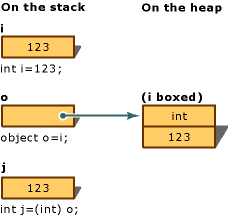
For the unboxing of value types to succeed at run time, the item being unboxed must be a reference to an object that was previously created by boxing an instance of that value type. Attempting to unbox null causes a System.NullReferenceException. Attempting to unbox a reference to an incompatible value type causes an System.InvalidCastException.
Example
The following example demonstrates a case of invalid unboxing and the resulting InvalidCastException. Using try and catch, an error message is displayed when the error occurs.
sample · csharpsamples/snippets/csharp/VS_Snippets_VBCSharp/CsProgGuideTypes/CS/Class1.cs20
//<snippet5555>
using System;
using System.Collections.Generic;
//</snippet5555>

namespace CsProgGuideTypes
{
    //-------------------------------------------------------------------------
    class BoxingAndUnboxing
    {
        static void Main()
        {
            //<Snippet14>
            int i = 123;
            // The following line boxes i.
            object o = i;
            //</Snippet14>

            //<Snippet15>
            o = 123;
            i = (int)o;  // unboxing
            //</Snippet15>

            //<Snippet47>
            // String.Concat example.
            // String.Concat has many versions. Rest the mouse pointer on
            // Concat in the following statement to verify that the version
            // that is used here takes three object arguments. Both 42 and
            // true must be boxed.
            Console.WriteLine(String.Concat("Answer", 42, true));

            // List example.
            // Create a list of objects to hold a heterogeneous collection
            // of elements.
            List<object> mixedList = [];

            // Add a string element to the list.
            mixedList.Add("First Group:");

            // Add some integers to the list.
            for (int j = 1; j < 5; j++)
            {
                // Rest the mouse pointer over j to verify that you are adding
                // an int to a list of objects. Each element j is boxed when
                // you add j to mixedList.
                mixedList.Add(j);
            }

            // Add another string and more integers.
            mixedList.Add("Second Group:");
            for (int j = 5; j < 10; j++)
            {
                mixedList.Add(j);
            }

            // Display the elements in the list. Declare the loop variable by
            // using var, so that the compiler assigns its type.
            foreach (var item in mixedList)
            {
                // Rest the mouse pointer over item to verify that the elements
                // of mixedList are objects.
                Console.WriteLine(item);
            }

            // The following loop sums the squares of the first group of boxed
            // integers in mixedList. The list elements are objects, and cannot
            // be multiplied or added to the sum until they are unboxed. The
            // unboxing must be done explicitly.
            var sum = 0;
            for (var j = 1; j < 5; j++)
            {
                // The following statement causes a compiler error: Operator
                // '*' cannot be applied to operands of type 'object' and
                // 'object'.
                //sum += mixedList[j] * mixedList[j];

                // After the list elements are unboxed, the computation does
                // not cause a compiler error.
                sum += (int)mixedList[j] * (int)mixedList[j];
            }

            Console.WriteLine($"Sum: {sum}");

            // Output:
            // Answer42True
            // First Group:
            // 1
            // 2
            // 3
            // 4
            // Second Group:
            // 5
            // 6
            // 7
            // 8
            // 9
            // Sum: 30
            //</Snippet47>
        }

        static void Wrap()
        {
            //<Snippet21>
            int i = 123;      // a value type
            object o = i;     // boxing
            int j = (int)o;   // unboxing
            //</Snippet21>
        }
    }


    //-------------------------------------------------------------------------
    class BoxingValueCopy
    {
        static void Main()
        {
            //<Snippet16>
            // Create an int variable
            int i = 123;

            // Box the value type into an object reference
            object o = i;  // boxing

            // Display the initial values
            Console.WriteLine($"Value of i: {i}");
            Console.WriteLine($"Value of boxed object o: {o}");

            // Modify the original value type
            i = 456;

            // Display the values after modification
            Console.WriteLine("\nAfter changing i to 456:");
            Console.WriteLine($"Value of i: {i}");
            Console.WriteLine($"Value of boxed object o: {o}");

    		// Output:
    		// Value of i: 123
    		// Value of boxed object o: 123

    		// After changing i to 456:
    		// Value of i: 456
    		// Value of boxed object o: 123
            //</Snippet16>
        }
    }

    //-------------------------------------------------------------------------
    class TestBoxing
    {
        static void Main()
        {
            //<Snippet17>
            int i = 123;
            //</Snippet17>

            //<Snippet18>
            // Boxing copies the value of i into object o.
            object o = i;
            //</Snippet18>
        }
    }

    //-------------------------------------------------------------------------
    class WrapExplicitBoxing
    {
        static void Main()
        {
            //<Snippet19>
            int i = 123;
            object o = (object)i;  // explicit boxing
            //</Snippet19>
        }
    }

    //-------------------------------------------------------------------------
    //<Snippet20>
    class TestUnboxing
    {
        static void Main()
        {
            int i = 123;
            object o = i;  // implicit boxing

            try
            {
                int j = (short)o;  // attempt to unbox

                Console.WriteLine("Unboxing OK.");
            }
            catch (InvalidCastException e)
            {
                Console.WriteLine($"{e.Message} Error: Incorrect unboxing.");
            }
        }
    }
    //</Snippet20>

    //-------------------------------------------------------------------------
    public class ConvertByteArrayExample
    {
        static void Main(string[] args)
        {
            //<Snippet22>
            byte[] bytes = [0, 0, 0, 25];

            // If the system architecture is little-endian (that is, little end first),
            // reverse the byte array.
            if (BitConverter.IsLittleEndian)
                Array.Reverse(bytes);

            int i = BitConverter.ToInt32(bytes, 0);
            Console.WriteLine($"int: {i}");
            // Output: int: 25
            //</Snippet22>
        }
    }

    //-------------------------------------------------------------------------
    public class ConvertByteArrayExample2
    {
        static void Main(string[] args)
        {
            //<Snippet23>
            byte[] bytes = BitConverter.GetBytes(201805978);
            Console.WriteLine($"byte array: {BitConverter.ToString(bytes)}");
            // Output: byte array: 9A-50-07-0C
            //</Snippet23>
        }
    }

    //-------------------------------------------------------------------------
    public class ConvertHexadecimalStrings
    {
        static void Main(string[] args)
        {
            //<Snippet30>
            string input = "Hello World!";
            char[] values = input.ToCharArray();
            foreach (char letter in values)
            {
                // Get the integral value of the character.
                int value = Convert.ToInt32(letter);
                // Convert the integer value to a hexadecimal value in string form.
                Console.WriteLine($"Hexadecimal value of {letter} is {value:X}");
            }
            /* Output:
                Hexadecimal value of H is 48
                Hexadecimal value of e is 65
                Hexadecimal value of l is 6C
                Hexadecimal value of l is 6C
                Hexadecimal value of o is 6F
                Hexadecimal value of   is 20
                Hexadecimal value of W is 57
                Hexadecimal value of o is 6F
                Hexadecimal value of r is 72
                Hexadecimal value of l is 6C
                Hexadecimal value of d is 64
                Hexadecimal value of ! is 21
             */
            //</Snippet30>

            //<Snippet31>
            string hexValues = "48 65 6C 6C 6F 20 57 6F 72 6C 64 21";
            string[] hexValuesSplit = hexValues.Split(' ');
            foreach (string hex in hexValuesSplit)
            {
                // Convert the number expressed in base-16 to an integer.
                int value = Convert.ToInt32(hex, 16);
                // Get the character corresponding to the integral value.
                string stringValue = char.ConvertFromUtf32(value);
                char charValue = (char)value;
                Console.WriteLine("hexadecimal value = {0}, int value = {1}, char value = {2} or {3}",
                                    hex, value, stringValue, charValue);
            }
            /* Output:
                hexadecimal value = 48, int value = 72, char value = H or H
                hexadecimal value = 65, int value = 101, char value = e or e
                hexadecimal value = 6C, int value = 108, char value = l or l
                hexadecimal value = 6C, int value = 108, char value = l or l
                hexadecimal value = 6F, int value = 111, char value = o or o
                hexadecimal value = 20, int value = 32, char value =   or
                hexadecimal value = 57, int value = 87, char value = W or W
                hexadecimal value = 6F, int value = 111, char value = o or o
                hexadecimal value = 72, int value = 114, char value = r or r
                hexadecimal value = 6C, int value = 108, char value = l or l
                hexadecimal value = 64, int value = 100, char value = d or d
                hexadecimal value = 21, int value = 33, char value = ! or !
            */
            //</Snippet31>

            //<Snippet32>
            string hexString = "8E2";
            int num = int.Parse(hexString, System.Globalization.NumberStyles.HexNumber);
            Console.WriteLine(num);
            //Output: 2274
            //</Snippet32>

            //see also snippet38 below
        }
    }

    class ConvertHexStrings2
    {
        static void Main()
        {
            //<snippet38>
            byte[] vals = [0x01, 0xAA, 0xB1, 0xDC, 0x10, 0xDD];

            string str = BitConverter.ToString(vals);
            Console.WriteLine(str);

            str = BitConverter.ToString(vals).Replace("-", "");
            Console.WriteLine(str);

            /*Output:
              01-AA-B1-DC-10-DD
              01AAB1DC10DD
             */
            //</snippet38>

            //<snippet39>

            string hexString = "43480170";
            uint num = uint.Parse(hexString, System.Globalization.NumberStyles.AllowHexSpecifier);

            byte[] floatVals = BitConverter.GetBytes(num);
            float f = BitConverter.ToSingle(floatVals, 0);
            Console.WriteLine($"float convert = {f}");

            // Output: 200.0056
            //</snippet39>

            //<snippet48>
            byte[] array = [0x64, 0x6f, 0x74, 0x63, 0x65, 0x74];

            string hexValue = Convert.ToHexString(array);
            Console.WriteLine(hexValue);

            /*Output:
              646F74636574
             */
            //</snippet48>
            // Keep the console window open in debug mode.
            System.Console.WriteLine("Press any key to exit.");
            System.Console.ReadKey();
        }
    }
}
This program outputs:
Specified cast is not valid. Error: Incorrect unboxing.
If you change the statement:
int j = (short)o;To:
int j = (int)o;The conversion is performed, and you'll get the output:
Unboxing OK.
C# language specification
For more information, see the C# Language Specification. The language specification is the definitive source for C# syntax and usage.